


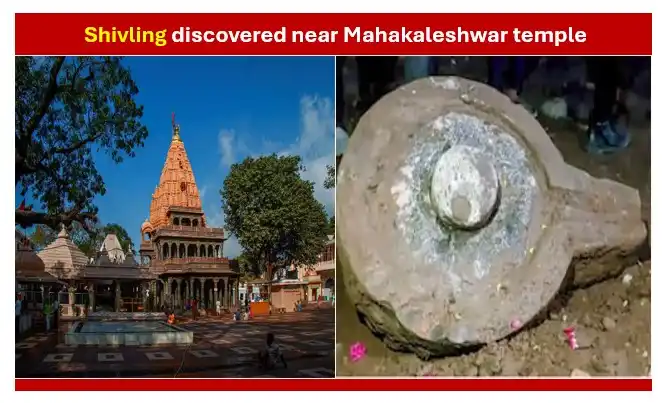
Ujjain, a prominent ancient city, has recently seen immense growth from the discovery of a Shivling near Mahakaleshwar Temple – one of 12 Jyotirlingayas that represent Lord Shiva – drawing many followers of faith as well historians and archeologists alike through spiritual and study-related aspects surrounding such as recent excavations and the overall long-standing history/beliefs associated with the temple itself.
Details of the Excavation Site: Ujjain Witnesses Significant Religious Find
Details of the area where the Shivling was found are: it was found during a routine excavation as part of developing new infrastructure or restoration work in order to accommodate more pilgrims who visit Mahakaleshwar Temple. When workers began to excavate previous to this find, they accidentally came across large rounded stones found under the soil; when they cleared away the dirt all they could see were wet rocks; after further investigation turned out to be another form of a Shivling located above ground level, around that same time supervisor put a hold on any more digging until further notice to many outside sources consulted before proceeding.) The location where it was located has now been closed off completely until the appropriate actions for both parties involved have resolved all issues.
also read: India’s First Barrier-Free Toll Plaza Opens on Mumbai–Delhi Highway
Religious Significance and Devotee Reactions
The discovery of the Shivling has great significance for many worshippers of Lord Shiva; many believe these discoveries are also divine signs and not just coincidences. The news of the Shivling’s discovery rapidly spread throughout Ujjain and the surrounding area, generating interest from both pilgrims anxious to worship at the site and residents wishing to see the site or prayer at it from a distance.
Religious leaders have expressed gratitude and asked that appropriate procedures be followed. Some of the priests working at Mahakaleshwar Temple feel confident that this Shivling is ancient and may have previously been part of a previously unknown shrine or a separate structure. People have already begun chanting and praying at the site to show their deep emotional and spiritual connection to such finds.
also read: Indian-American banker fired by JP Morgan got hired by Citibank
An Archaeological Perspective – Historical Context to Discovery
From an archaeology perspective, a study of this Shivling may yield significant information about Ujjain’s historical and cultural background. Ujjain has been an important site for both religion and education for centuries. The city continues to demonstrate evidence of many different layers of history. Experts are expected to perform tests to determine the Shivling’s age, origin and material composition. If a study determines that this Shivling is an ancient archaeological artifact, it may be evidence of the existence of older temple complexes or previously unknown places of worship in Ujjain.
Archaeological studies may also be undertaken by examining the soil and artifacts that can found in the surrounding area of this Shivling in order to try to provide a broader perspective of the context of the discovery. More excavations and maybe further discoveries of the same or similar nature.
Administrative Response/Preservation Efforts
The local authorities have responded promptly by delimiting the area with a barrier and setting up a joint communications effort with the archaeology departments. They reaffirmed the necessity of all parties to exercise utmost care in this situation, as it involves balancing emotions and belief systems from a religious standpoint versus history and science.
There is a continuing conversation regarding the Shiva Ling that is permanently located in the area, whether this will remain or if it should be moved for preservation and study. This determination will probably involve discussions with religious officials, historians and government officials.
In addition to increasing the security force for managing the growing number of visitors to the area, the increased security will allow the authorities to prevent the ability of an unauthorized person to tamper with, destroy or otherwise interfere with the various items that will now be found and removed from the area.
Potential Economic Impacts of Tourism/Economic Activity in the Area
The discovery is estimated to enhance the extent of religious tourism for Ujjain, an existing pilgrimage site located in this area. This increase in the number of visitors to the Ujjain area will also be beneficial to the Ujjain area’s businesses, including motels/hotels, retail shops, transportation services, etc.
It is a priority for local authorities to effectively manage the crowds of people that will be present in this area. The authorities are also very cognizant of this being a significant religious site, close to the Mahakaleshwar Temple, from a religious standpoint. If the site is developed correctly, it can be a new way for people to learn about Ujjain and its culture and spirituality.
Conclusion: A Fusion of Faith and Investigation
The discovery of the Shivling in the vicinity of the Mahakaleshwar Temple is both a source of faith for those who believe the deity revealed Himself through the uncovering of the idol and a source of exploration for those who want to learn more about the historical aspects of the region.
While research continues on this find, it reminds us that India has a rich and varied heritage; parts of that heritage are spiritual and parts are historical, but they are often layered together at levels below the earth waiting to be discovered.
