


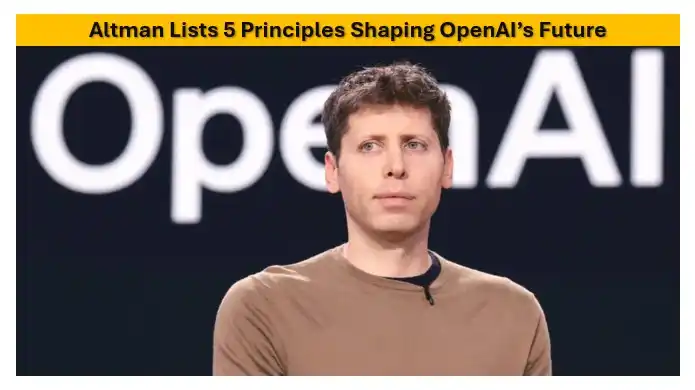
Sam Altman has expressed 5 “principles” that give insight into the direction in which OpenAI will develop its business. While these are not definitive plans, they show how the company’s thinking will progress as it grows rapidly, faces intense competition, and gets more scrutiny from around the world.
Here is a structured summary of these 5 principles, along with possible implications for the future:
1. Long-Term Benefit Takes Precedence Over Immediate Profitability
Altman has stated that OpenAI intends to develop technology that creates long-term value as opposed to short-term, quick profits. This principle suggests that OpenAI will likely continue making large investments in basic AI-models, even when there is uncertainty and delay in generating returns on these investments.
As an example, there may be fewer “quick monetization opportunities” and a focus on developing more disruptive capabilities. This principle also suggests that OpenAI is willing to tolerate short-term financial losses if it has confidence that, based on the likelihood of success over time in terms of building advanced AI-systems, making these investments is worth the risk.
2. A Focus On Iterative Releases In the Strategy
OpenAI has never waited for its systems to be fully developed before releasing them out into the marketplace. In creating new systems/models, OpenAI has used a consistent iteration of “develop, learn, improve.” Altman stated that this is an ongoing process and is the cornerstone of their decision process.
This method means that users can contribute their experiences to improve the tool, but it also means that the company will continue to create versions that lack certain features or capabilities. Business and end users should expect continued modifications, changes to how the tool works, and the ability to use the tool in a different way as part of the life cycle of the product.
3. The Need to Balance Safety and Accessibility
Altman stated that there are two opposing viewpoints regarding the widespread availability of AI (which is what OpenAI beams support for), and being responsible with its use (which is somewhat contradictory). Future decisions made by OpenAI seem to be focused on trying to strike a balance between those two viewpoints.
On one side of the fence, OpenAI would like to see its products be adopted by more users in different industries and areas. Conversely, due to increasing regulatory and public scrutiny to reduce misuse of the technology, OpenAI will likely continue to develop a more extensive framework through additional layers of access, policy frameworks, and/or specific region benchmarks as a means of balancing these two issues more effectively.
4. Evolving from Products to Platforms
One of the general themes that Altman discussed was the movement away from being a standalone tool provider and into a larger ecosystem. OpenAI appears to be increasingly positioning itself as a platform for other developers, businesses, and other partners to leverage and build on its models (similar to how many software technology companies currently provide their products in this manner).
This suggests that OpenAI’s future will include API, integration, and enterprise solutions as a bigger priority than creating consumer apps alone. The success of OpenAI may depend more upon how extensively their technology becomes integrated into other solutions; rather than being developed as independent products.
5. Business Models that Adapt to Changes in Technology
Altman indicated that revenue and pricing strategies used by companies today are not likely to translate well into the AI domain, so OpenAI’s method of supplying products will evolve alongside technological advancement. Being open to redesigning their billing methods will allow OpenAI to explore many options, such as subscriptions, pay-as-you-go, or perhaps even finding an altogether different way of doing business. It shows that they’re prepared to make quick strategic changes if market conditions or user preferences dictate.
What Do These Principles Mean?
All of these five principles demonstrate that OpenAI appears intent on implementation of flexible plans versus formalized ones. Therefore, OpenAI seems committed to goals related to flexibility across technology, commercial and ethical practices.
Competitors should view an organization like OpenAI that is willing to commit financial resources to gain successful outcomes using flexible and quickly adapt planning as a formidable competitor. Users and partners should expect new products, frequent revisions to policies, and new capabilities as local market conditions change.
Also implicit in the AI industry is that it’s constantly evolving and becoming concretely defined. In fact, since OpenAI has left their principles more general, they actually create flexibility for themselves to adapt to new issues and opportunities that develop over time.
The Bigger Picture
The framework that Altman has created also reflects the larger level of uncertainty associated with AI. The question of regulation, safety, economic effects, and the competition between the developing countries, is still up for ultimate determination.
OpenAI has positioned themselves based on decisions that are anchored in long-term impacts, continual learning, and flexible application of those decisions in order to collectively manage and operate through the uncertainty, rather than to be able to predict with absolute accuracy what will happen.
How successful this will be ultimately will depend upon how open and responsible, how quickly and responsibly these principles can all be combined and incorporated by OpenAI into their future decisions. There are several changes that are necessary to be made, but these are the five overarching principles through which OpenAI should be viewed for how they will continue to make these larger decisions in their future.
Conclusion
Altman has created a philosophy more than a plan through which to operate by that outlines that OpenAI and other companies should build quickly, think long-term, remain flexible, and be aware of the broader implications of their work. This is the mentality through which not only will OpenAI continue to grow, but ultimately the entire AI industry.
