


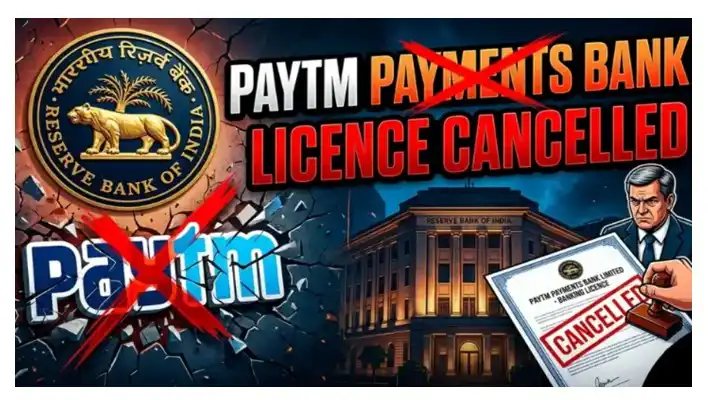
The Reserve Bank of India (RBI) has revoked Paytm Payments Bank’s banking license effective April 24, 2026, meaning that the bank will no longer provide any banking services. The RBI has been conducting an extensive review of Paytm Payments Bank’s governance and compliance with the banking system’s regulations, and found many serious compliance-related issues with the governance of Paytm Payments Bank, as well as deficiencies in its KYC processes.
As a result, due to regulatory restrictions, Paytm Payments Bank has been unable to accept new customers or deposits from early 2024 onward. Therefore, this action will effectively end the existence of Paytm Payments Bank and will begin the formal court process to close the bank down permanently.
Why did the RBI take this action?
The RBI is revoking the banking license for Paytm Payments Bank because of ongoing non-compliance with their regulations and policies and therefore that the bank’s operations are not in the best interest of depositors or of the general public. The RBI has cited deficiencies in Paytm Payments Bank’s internal controls and also the lack of internal controls.
After a significant action against a fintech company in India, the Reserve Bank of India (RBI) has shown greater enforcement of regulatory measures to be applied to this fast-paced fintech environment.
read also: Meta confirms 8,000 employees laid off in one day
Users of Paytm Payment Bank
The revocation of the bank’s license has created minimal immediate impact on the majority of customers since they will be able to continue withdrawing their deposits. The RBI further assures that there exist sufficient funds in the Bank to cover all depositors.
The Bank’s license will not prevent it from discontinuing banking, offering banking products or propose to become a registered financial institution(s) over time until they have completely ceased operations.
read also: 2% DA Hike Approved for Central Government Employees
UPI Users of Paytm
Questions (frequently asked) have arisen about whether users who used the Bank will be allowed to continue utilizing UPI through Paytm after the closure of the Bank. Good news is, UPI through Paytm remains operative currently.
At this time, users will still be able to process UPI transactions as well as QR code payments, and pay bills with UPI as these transactions are processed by partner banks rather than only the Paytm Payment Bank.
In addition, Paytm Payments Bank’s UPI services were migrated to a multi-bank UPI infrastructure, including Paytm’s partner, Yes Bank. Therefore, even after the Paytm Payments Bank’s banking license is permanently revoked, UPI services provided by Paytm Payments Bank will continue to be available.
Will UPI Service Interruptions Be a Future Possibility?
Currently, Paytm Payments Bank UPI users are not experiencing many issues with their services. However, some customers who have directly linked their Paytm Payments Bank accounts to UPI accounts may experience future service interruptions.
If you are one of these customers, you will need to:
- Create a new bank account to be connected with your UPI account
- Change your recurring and autopay payments that were previously linked with your Paytm Payments Bank account and
- Use the money in your Paytm Payments Bank account or close that account.
Experts believe the transition period will occur gradually to give users sufficient time to switch to using another bank.
Impact on Businesses and Merchants
Businesses accepting payment from consumers via Paytm’s QR or payment plan will not be impacted too much by the settlement of their transactions. Regardless of whether or not the Paytm Payments Bank receives its banking license, merchants will still be receiving settlements on their transactions from Paytm Payments Bank.
That said, it is possible that the backend settlement process and the banking relationship with merchants will change over time, meaning that merchants may need to update their account information or settlement preference in the future.
Broader Implications for Digital Payments
The RBI seems to be sending a message to all fintech companies that they should adhere to regulations—if they have not already. In other words, fintech companies that grow quickly must have the financial and operational support of appropriate governance, risk management, etc., in place before expanding their business.
At the same time, the limited effect of the RBI’s decision on UPI users illustrates the resiliency of the digital payment system in India. The multi-bank UPI system allows for continued processing, as the UPI infrastructure operates as one large bank even if a single bank leaves the system; all parties still will do business as usual.
In conclusion, the cancellation of the Paytm Payments Bank licence represents a watershed moment in the Indian fintech landscape. UPI users should have no immediate concerns; they are able to continue making payments, transferring money and conducting daily business as normal.
However, it is in the users’ best interest to stay informed about any new announcements and to take steps to reduce their dependency on Paytm Payments’ Bank as the winding-down of its operations will happen gradually.
