


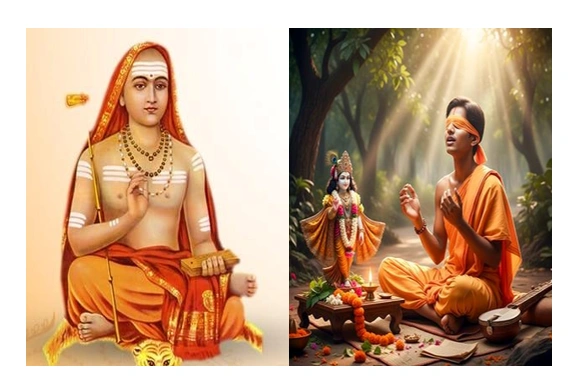
Two spiritual festivals in India—Adi Shankaracharya Jayanti and Surdas Jayanti—will happen on April 21, 2026. Both saints shaped Indian religion and philosophy. Whereas Shankaracharya brought life to Advaita Vedanta, Surdas added to the body of Bhakti literature through his poetic works.
Adi Shankaracharya Jayanti
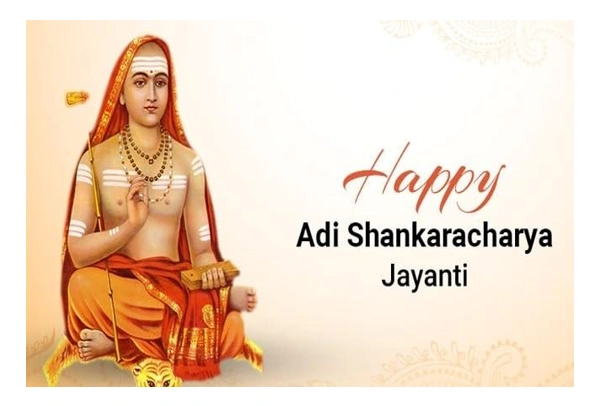
Adi Shankaracharya (8th century CE) is a significant Hindu philosopher and theologian. He established Advaita Vedanta by combining all major schools of Vedanta into one. Advaita’s essential teaching is the Oneness between individual beings (Atman) and the Absolute Reality (Brahman), as opposed to believing in the duality of living beings.
Importance
Adi Shankaracharya Jayanti celebrates his life, accomplishments, and development as a philosopher, and recognizes his place in Hindu philosophy. He restored the Sanatan Dharma when it was in chaos, and eventually laid the groundwork for four major mathas in India through his teachings, which stress individual self-realization, ज्ञान (knowledge), and relinquishing attachments to worldly appearances.
Ways of Celebration
- There are regular gatherings for discourses on Vedanta and Guru Sri Adi Shankaracharya’s teachings in temples and ashrams.
- Devotees have the opportunity to read the Guru’s works, e.g. Vivekachudamani and Bhaja Govindam
- Devotees meet regularly for spiritual events, such as bhajans and Satsangs
- They journey to the mathas (ashrams) founded by the Guru.
Rituals include:
- -Daily early morning bath (snan) and meditation
- -Ritualistic puja (worship) of the Guru and presentation of flowers and incense
- -Reciting of Vedic mantras and advaitic texts
- -Charity to Brahmins and the less fortunate
Mantra
A commonly recited mantra in honor of Adi Shankaracharya:
“Bhaja Govindam Bhaja Govindam
Govindam Bhaja Mudhamate”
This verse emphasizes devotion over mere intellectual knowledge.
Do’s
- Engage in self-reflection and meditation.
- Study spiritual texts and teachings.
- Practice simplicity and humility.
- Offer charity and serve those in need.
Don’ts
- Avoid ego (ahankaar) and being attached to material possessions.
- Debate or argue unnecessarily.
- Avoid negativity/influence, and distraction.
Read also: 13 April- varuthini Ekadashi, Vallabhacharya Jayanti
Surdas Jayanti
Surdas Jayanti commemorates the birthday of one of the greatest bhakti poets. Surdas’s poems are important because they helped spread bhakti by allowing all people to access devotion through simple language and emotional depth.
Importance of Surdas Jayanti
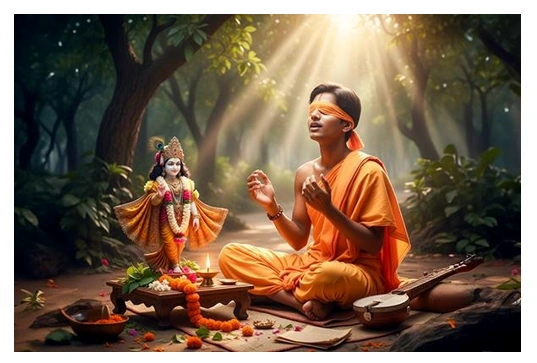
Surdas was a blind poet and saint who lived in the 1500s and 1600s and was known for being deeply devoted to Krishna. Surdas composed many poems, but the most well-known are the poems in the Sursagar, where he describes Krishna’s childhood (बाल लीला) and his love for Krishna.
Ways of Celebration
- Shri Krishna’s bhajans and kirtans are sung at temples.
- Verses of Sursagar are recited as a spiritual practice, where devotees join together in dramatizing Krishna Leela and participating in gatherings that foster devotion (bhakti).
Devotional rituals include:
- Honor the Lord Krishna with flowers, Tulsi leaves and sweets
- Offer bhog (food) of butter (Makhan) and sweets (mithai)
- Sing bhajans to the glory of Lord Krishna
- Offer light and perform Arati to Guru and Lord Krishna
Mantra / Bhajan
A popular Surdas composition:
“Maiya Mori Main Nahin Makhan Khayo”
This playful bhajan reflects Krishna’s childhood innocence and divine charm.
Do’s
- Participate in devotional singing and remembering Krishna.
- Develop and practice love, compassion and humility.
- Listen to or recite the poetry of Surdas.
- Engage in Satsang and Kirtan.
Don’ts
- Avoid ego (ahankaar) and being harsh.
- Refrain from disrespecting devotional practices.
- Avoid distractions that pull one away from a devotional practice.
Read also: 19 April 2026 – Akshay Tritiya, Nashik Kartigayi, Parashuram Jayanti
Conclusion
The two separate yet parallel paths of spirituality offered in Hinduism are represented by Adi Shankaracharya Jayanti (the path of ज्ञान—knowledge) and Surdas Jayanti (the path of भक्ति—devotion). Through the medium of intellect and inquiry, Adi Shankaracharya provides an opportunity for seekers to discover themselves; on the other hand, through total submission to the Divine and loving the Divine, Surdas provides a different opportunity for seekers. Therefore each of these celebrations (festivals) helps those who are on the spiritual journey create a harmony between knowledge and devotion.
