


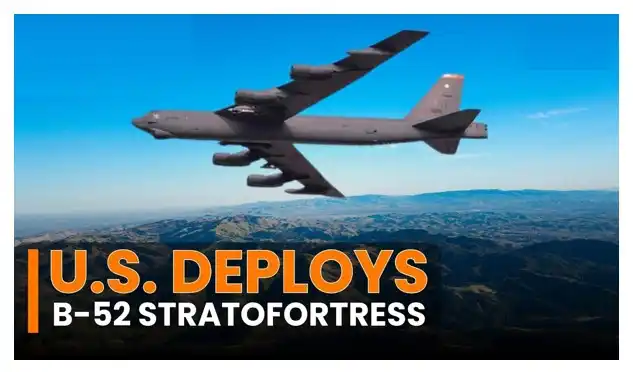
In response to an escalation of conflict with Iran, the U.S. has undertaken aerial operations using B-52 Stratofortress bombers over land inside Iranian airspace. According to U.S. military officials, this indicates a high degree of confidence by the U.S. and its allies in their ability to secure Iranian airspace.
Strategic Shift in Air Campaign
Historically, U.S. conducted aerial operations have relied heavily on stealth platforms and long-range strike capabilities; the deployment of B-52 bombers, large non-stealthy bombers, represents a clear transition toward sustained and highly visible air operations directly over the territory of Iran.
With “increased air superiority” over the territory of Iran, the combination of U.S. and allied degradation of Iranian air defense systems through direct strikes, cyber capabilities, and electronic warfare has enabled the use of B-52s. Because Iranian air defenses have been degraded to the point where they no longer can present a meaningful threat, it is possible for slower, large-capacity bombers, such as B-52s, to operate in this environment with minimal risk. B-52s have not typically been employed to conduct aerial operations in environments where they can safely operate, due to modern air defenses.
also read: Donald Trump open to ending Iran war
Scale of Military Operations
More than 11,000 sites in Iran were hit by aerial bombardment during a recent B-52 mission as part of the large U.S.-led air campaign to defeat Iranian forces.
According to military officials, these sites included missile factories, ships, defence-industrial production/storage, and suspected nuclear-related sites.
The apparent scale and intensity of these airstrikes suggests that the U.S.-led coalition intends to continue to attack and destroy Iran’s military capability, thereby limiting its ability to retaliate against U.S. and coalition members.
The B-52 bomber is a jet that has been around since the 1950s and remains one of the U.S. Air Force’s most powerful and versatile aircraft. It has been successfully used for many years, dropping large quantities of bombs, including precision-guided bombs, over great distances.
The B-52 bomber has a distinct operational advantage when there are no longer air defence systems and high-capacity bombers can deliver multiple, large quantities of attacks much more efficiently than stealthy bombers can alone. The expectation is that the B-52 will remain in service for many more years with continued improvement in engines, as well as radar systems.
also read: Trump Says He Received Gift from Iran’s Ghalibaf
Broader Military and Political Context
The increase in the hostilities is occurring as the U.S.-Iran conflict continues to build on itself, with military and diplomatic options moving simultaneously. On the military side, the U.S. is beginning to conduct extensive air operations, while also attempting to negotiate limits on Iran’s nuclear capabilities.
At the same time, there are rising tensions throughout the region, including additional deployment of U.S. forces and fears that Iran and other regional players may seek to escalate hostilities further.
World Events, Implication and Risk to the U.S
The utilization of B-52 bombers for overland missions represents a more serious stage of the hostilities and has occurred with an increased frequency of air operations and targeting. Analysts are concerned that although the U.S. has the ability to conduct air operations in a manner that gives it an upper hand over the other parties engaged in the hostilities, there is also a risk of providing an incentive for Iran, or an ally of Iran, to respond with a more lethal counterstrike.
From this development, it is reasonable to view the shift from precision, tactical attacks to more expansive, sustained air war as the likely future direction of the U.S.-Iran conflict over the next several weeks.
