


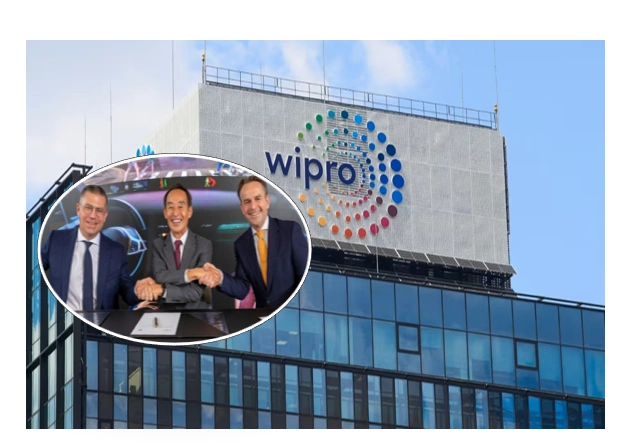
The new digital transformation has silently replaced the old in the commercial and neon lights-filled center of Seoul. Wipro Limited finally unveiled its new Innovation Lab in Seoul , which represents a huge gamble on South Korea being a high-tech powerhouse on the world stage.
To the novice, this is not any other office opening. It is a strategic action that positions Wipro in the heart of a Perfect Storm of technology: the convergence of semiconductors, automotive engineering and the fast-growing emergence of Software-Defined Vehicles (SDVs). It is not only providing services by increasing its presence in Seoul but also creating a bridge between Indian software strengths and South Korean hardware hegemony.
The Future of the Sandbox: What Goes On in the Lab?
The new jewel is the Seoul Innovation Lab which has recently been minted within the Wipro Innovation Network (WIN). It is the ninth facility of the company in the world and the fifth in the APMEA (Asia Pacific, India, Middle East, and Africa) region. But what does happen inside?
Consider the lab a sandbox with high-tech. It is a joint facility in which the engineers of Wipro work shoulder-to-shoulder with South Korean businesses to develop solutions which did not exist a day ago.
Three primary pillars
It takes laser-focus on three primary pillars:
Revolution of Software-Defined Vehicles (SDV)
South Korea boasts of automotive giants that are some of the most ambitious in the world. With the cars becoming more of a computer on wheels rather than a machine with computers, SDV engineering is becoming the specialization of the lab. This includes cloud-based infotainment down to the sophisticated AI that drives car autopilot.
Clever Supply Chain and Supply Chain Resilience
With the world still yet to overcome the logistical spasms of the early 2020s, the Seoul laboratory is deploying Wipro Intelligence™ the firms own AI platform to construct smarter factories. The lab can assist Korean manufacturers to keep up with their rivals in a hyper-competitive global market by simulating disruptions in their supply chain and allowing AI to optimize production on-the-fly.
Sophisticated Product Engineering
The lab is not only full of cars and factories, but it is also the center of Intelligent Product Engineering. This implies using the ordinary industrial tools and attaching the brains (AI) and the nervous system (5G/6G) to carry out autonomously.
Read also: Wipro Tightens Hybrid Policy With Mandatory Six Hour Office Rule
The Samsung Synergy: Making use of the HARMAN Acquisition
To see the rationale behind Wipro expanding so aggressively in Korea at this point, the question is, why look in 2025. The Wipro company has made a successful acquisition of the Digital Transformation Solutions (DTS) unit of HARMAN International, a subsidiary of Samsung Electronics, a Korean titan, in the year before.
This was not a mere financial deal, it was a huge talent injection. The transaction made available more than 5,000 professionals, including a significant number of them right here in South Korea, under the Wipro umbrella. The physical residence of this newly incorporated expertise is the new Seoul Innovation Lab. The merger between HARMAN and Wipro has formed a one-stop-shop solution to any Korean company seeking to take its innovations to the world by leveraging on the global delivery system of Wipro as well as the deep automotive and electronic background of HARMAN.
Read also: The Quiet Revolution: How Samsung’s AI is Humanizing
Humanizing the Technologies: Investing in the Local Soul of Seoul
As much as the headlines tend to talk about chips and code, the leadership at Wipro is just talking about a more human aspect, namely local talent.
South Korea is a strategic growth market to Wipro and an ever-growing global innovation centre, remarked Vinay Firake, CEO of the Wipro APMEA Strategic market unit. He does not only have a vision of importing Indian talent, but also developing the local ecosystem.
The expansion is not limited to the number of hundreds of professionals already employed by Wipro in South Korea. The company has enacted continued collaboration with South Korean academic powerhouses. It is aimed at retraining early professionals in specialties such as Generative AI and 6G connectivity. This would make sure that the invention of the Seoul lab has a clearly defined DNA of made in Korea with international backbone.
