


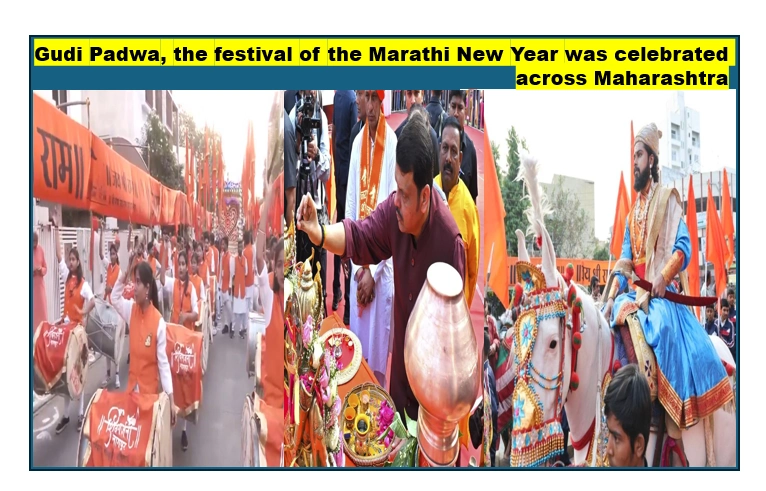
The air nowadays in Maharashtra, full of the scent of pulverized marigolds, of the chest-thumping, chest-vibrating vibration of dhol-tashas. And when this Thursday morning, March 19, 2026, the sun came rising over the Western Ghats, the state not only awoke, but out of it sprinkled a mass of saffron and festivity. Gudi Padwa, the Marathi New Year, was never a date in a lunar calendar only, it is a mass inhalation, and the collision between the old and the new in the small lanes of Girgaon, in the busy Dome in Pune, and the old streets of Nagpur.
This year the celebrations were especially personal as Chief Minister Devendra Fadnavis left the sterile political sphere of policy meetings and budget sessions to go down to the ground with the people. The CM was not only a political figure in his native Nagpur, he was a son of the soil, and his attendance at the great Shobha Yatra with a vitality which was hard to believe was an infectious one, and reflected thousands of people around him.
Saffron Sea: Nagpur Shobha Yatra
At Nagpur the air was tingling. The city was made to be what people in the town referred to as a Bhagwa (saffron) wonderland. A traditional procession of the New Year, the Shobha Yatra, was kilometer long, with more grandiose tableaux that replicated scenes in the life of Chhatrapati Shivaji Maharaj and the entry of Lord Ram in Ayodhya.
CM Fadnavis, who wore traditional wear and a bright pheta (turban), was strolling with the residents, shaking hands with the elders often enough and applauding with the youth dancing on Lezim.
It is the auspicious morning of the Hindu New Year, Chief Minister said to the assembled people competing with the shouts of Jai Shri Ram and the incessant pounding of the drums. The view of people of all ages, toddlers in their traditional attire and our seniors together celebrating our heritage is what actually defines Maharashtra.
Popular Marathi actress Sai Tamhankar accompanied by the CM gave the event a cinematic glamour but local Pathaks (drum troupes) were the actual stars. Their synchronized play was the result of several months of hard work, as they transformed the streets into the theater of the percussion-based happiness.
Read also: From Fasting to Feasting: Eid al-Fitr, The Joyful Festival
Bitter, Sweet, and Resilient The Symbolism of the Gudi
After these huge processions, the core of Gudi Padwa is in the house. Each family in the state nailed the Gudi a shiny silk fabric tied to the bamboo pole and crowned with a copper or silver kalash; hung with neem leaves and sugar crystals (gathi).
The day rituals are also a sad metaphor to life itself. The customary drinking of a blend of neem and jaggery is bitter-sweet, is a reminder of the fact that the new year will be difficult and successful at the same time. The hoisting of the Gudi this morning, with the CM, in his recent budget statement, announcing a good deal of loan waivers, was less a routine than a prayer of a debt-free successful future.
Read also: Morarji Desai National Institute of Yoga to organise Yoga Mahotsav 2026
A New Year in New Ambitions
Although the day has its origins in mythology, the 2026 celebrations were also squarely future oriented, even though this was a mythology that celebrated the day Lord Brahma created the universe. The Chief Minister was not simply there as a matter of tradition, but it was more of an on-record exercise of his vision of Developed Maharashtra 2047.
During the yatra, there were discussions involving the participants on the transition that the state is experiencing. In between AI-powered agricultural projects on the other, talked about in the recent budget, and the enormous infrastructural projects underway that are slowly boring holes through the Mumbai skyline, the Gudi Padwa of 2026 looks like a middle ground. It is a celebration in which the state commemorates its past and is planning a technological jump.
