


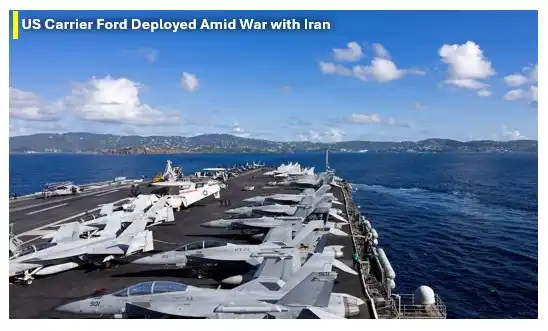
The USS Gerald R. Ford aircraft carrier, considered an essential part of America’s strategic military operations within the protracted war involving Iran, has been sent to operate as part of the overall United States military build-up in the Middle East designed to bolster allies in the region; increase pressure against Iran; illustrate the lengths Washington is willing to go in response to rising tensions with Tehran; and demonstrate how critical aircraft carriers are to modern warfare.
USS Gerald R. Ford as Command Ship of Carrier Strike Group
As the flagship of Carrier Strike Group 12 (CSG 12), USS Gerald R. Ford is capable of projecting tremendous amounts of combat power for extended periods at distances from the United States, with more than seventy-five aircraft capable of conducting sustained combat operations against enemy targets throughout its area of operations.
Throughout the ongoing conflict with Iran, air and ground-based (sea based) aircraft have played a pivotal role within CSG 12 in carrying out precision air strikes against Iranian military installations and supporting militant elements loyal to Iran. The carrier was equipped with advanced Air Warfare and Naval Strike Group (NSG) systems, which, when combined with its superior EMALS (electromagnetic aircraft launch system), allow it to exceed older-style conventional/steam-powered launches, thus allowing for quicker launches of aircraft from its deck during active combat operations.
Military experts have stated that a carrier’s presence in the region gives the United States a responsive platform to respond offensively and defensively—and a strong deterrent to Iran’s potential for escalation.
also read: Iran Leadership Crisis Deepens
Wider Presence of U.S. Military
The USS Ford, deployed to the Middle East, reflects a larger U.S. military build-up within the region. At the time of deployment, further U.S. resources such as fighter jets, refuelers and maritime vessels had already been relocated to the region following an increase in tensions between Tehran and the United States in 2026.
At one point, the United States considered deploying multiple aircraft carriers to the region, a process seldom done outside of a major war, in order to increase strike capabilities and allow for the continuities of American air support during hostilities, should the conflict continue to escalate.
An example of what a carrier strike group includes is a caliber of guided missile cruisers and destroyers that have advanced air defense and missile interception systems, creating a powerful naval formation that will allow for both offensive and defensive capabilities.
also read: Israeli PM Laughs Off Viral Death Rumours
Combat Operations and Airstrikes
Since the end of February 2026, U.S. military forces have conducted thousands of air strikes against Iranian targets and their regional military networks. All of these air operations have been carried out using carrier-based fighters, the F/A-18 Super Hornet, and stealth aircraft, the F-35C.
Among the many carriers supporting U.S. military operations, the USS Ford has played a crucial role by launching aircraft that provide support for coordinated air strikes along with land-based bomber forces and coalition partners. The goal of these operations has been to reduce Iranian military capabilities (especially against missile systems and associated drone infrastructures), as well as their naval capabilities, all of which could threaten both the commercial shipping and allied countries.
Through the ongoing pace of U.S. air operations, it is clear that aircraft carrier capabilities continue to be an integral part of U.S. military global strategy.
also read: Drone Strike Hits Italy-US Airbase in Kuwait
Shipboard Fire Produces Operational Challenges
In addition to being important for U.S. maritime operation strategic operations, the USS Ford is currently experiencing operational challenges resulting from a significant shipboard fire that occurred early in the morning on the ship in the ship’s laundry area. The fire required several hours to bring under control, while causing multiple sailors to suffer from shipboard smoke inhalation injuries, while causing damage to the quarters that are used daily by hundreds of crew members.
Due to this event, the vessel was redirected to a port to perform maintenance and receive support for logistics. While there was no impact to the carrier’s propulsion or overall combat readiness, it does indicate the burden that long duration deployments put on personnel and equipment.
Iran has made bold statements regarding U.S. carrier operations near its borders. Iranian leaders have publicly stated that all bases and implementation of naval operations to support the United States, can be deemed as legitimate targets in any potential conflict.
All of this demonstrates that the chances of an open conflict between the two nations is increasing. Analysts suggest that if the tension escalates, naval vessel deployed in that region are at risk of being attacked via missiles, drones, and naval mines.
Conclusion
The US has used aircraft carriers throughout history to fulfill their Military Strategy with the ability to support long-range air operations over sustained periods from anywhere in the world. The USS Gerald R Ford is providing the US with this ability to support operations from Afghanistan to Afghanistan via central Africa to Afghanistan.
Today, there is a heightened potential for conflict in the Middle East. With the present hostilities ongoing in the Middle East and continued operational challenges aboard the Ford, this means that the situation remains dramatic, with the potential for major conflict remaining high. The Ford’s deployment, therefore, indicates a commitment by the US to engage in the current conflict in the Middle East, as well as to increase military presence in the world’s most sensitive geopolitical location.
