


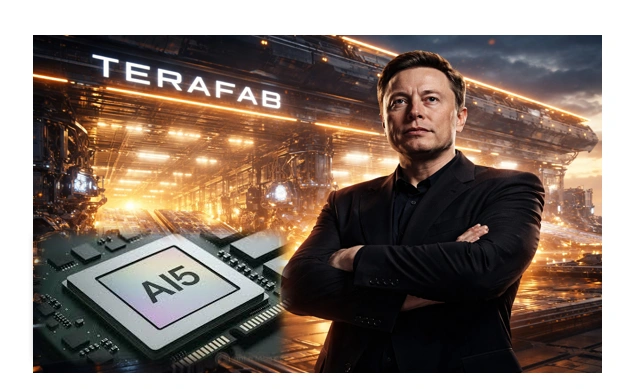
Elon Musk, the CEO of Tesla, has announced a big plan to build a big factory for making AI chips. It’s called the Terafab project. Starting on March 14, the project should go live within seven days. This marks a significant advancement for Tesla as it strives to enhance its AI and advanced computing capabilities.
The factory will likely make powerful AI chips that will be used in many of Tesla’s products. Key systems, like the company’s Full Self, will be able to use these chips. Driving technology and other powerful machine learning programs are built into its cars and AI systems.
Tesla’s ambitions extend far beyond manufacturing electric vehicles. The company is clearly aiming to expand its influence in the realms of artificial intelligence and technology.
The company wants to have better control over the computing power it needs for its future technologies by building its own chip factory.
Why Tesla wants to make its own chips
One of the main reasons for building Terafab is the growing need for AI chips that Tesla’s technologies rely on. High performance chips are very important to the company because they run software for self driving cars, robots, and AI data processing.
At the moment, Tesla relies on outside chipmakers to make its products. As the need for advanced chips grows worldwide, Elon Musk has said that relying solely on outside sources could cause problems in the future.
Tesla is planning to build a large factory that can produce a wide range of chip types so there aren’t any gaps. These are technologies like processing chips, memory parts, and chip packaging that are needed for high tech computers.
Tesla wants to ensure it has a steady supply of semiconductors for its long term AI plans by taking over more of the chip making process.
Read also: Elon Musk’s X Probes Grok Chatbot Over Racist and False Content
Tech companies that are involved with the project
Tesla wants to be able to make more chips on its own, but the company has already worked with a number of big technology companies. These companies are the engine, crafting the chips that power everything from computers to Tesla vehicles.
A few of the companies that are making chips for Tesla are Taiwan Semiconductor Manufacturing Company, Samsung Electronics, and Micron Technology. In the past, these companies have helped make chips that are used in Tesla’s power systems.
The company Intel has also been mentioned as a possible partner in making chips. Tesla wants to make more chips, so it may look for ways to work with more than one tech company. There isn’t an official deal yet, but these talks make it sound like they are.
Huge investments are planned for the facility
A lot of money is going to have to be spent on the Terafab project. Estimates from the start say that the building could cost anywhere from 20 billion to 30 billion dollars.
At the same time, Tesla is getting ready to spend a lot of money on new equipment in the next few years. During 2026, the company plans to spend about $20 billion on tools. This spending has nothing to do with how much it might cost to build the Terafab plant or do other big projects.
The amount of money that Tesla is spending shows how much it wants to focus on AI and computing power as part of its long term plan.
Read also: EU fines Elon Musk’s X $138 million; platform agrees to modify
AI chips will power Tesla’s new technologies
Tesla’s advanced technologies will depend on the next wave of AI chips that the company makes. These chips are made to handle the complicated machine learning models that are used in self-driving cars and other AI based apps.
Tesla is making its fifth generation AI chip right now. This chip will likely be used in cars, robots, and AI data centers. It is predicted that the new chip will work faster and use less power than older ones.
Through the Terafab project, Tesla aims to build a large, stable factory capable of producing many of these high tech chips. The project is part of the company’s larger plan to build a strong environment for artificial intelligence that serves its cars, robots, and new technology platforms.
