


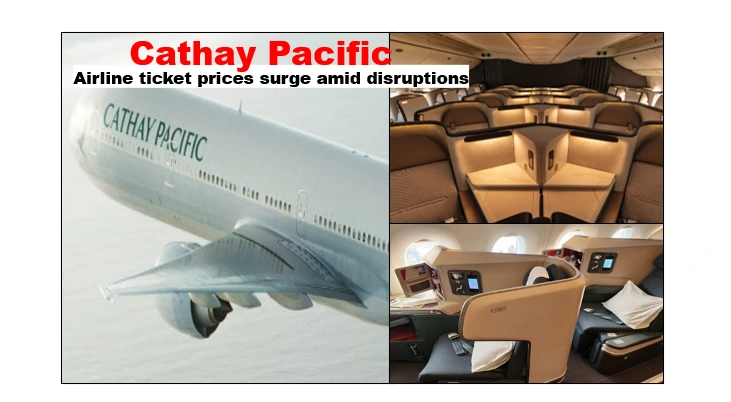
The cost of a ticket in the competitive and volatile global aviation industry has been a measure of geopolitical stability. This was reached to a shocking high this week when that barometer topped at a point of £20,000 one way by the Cathay Pacific airline between Sydney and London.
Although the number might be an accounting mistake, it is a cold, calculated impression of a changing world. By March 2026, one large-scale war between the U.S., Israel and Iran has virtually closed the so-called super-highways of the sky the Middle Eastern air routes. To Cathay Pacific, and to the thousands of passengers who are currently tigering over a seat, that price tag of 20,000 pounds will be the price of escaping a war zone.
The Great Reroute: Why It Costs a Fortune to Buy a Ticket
The Gulf centres of Doha, Abu Dhabi and Dubai have been the lounge to the world, uniting the east with the west and making it surgically effective. That efficiency proved to be gone in one night on February 28, 2026, as missile attacks and the subsequent airspace bans over Iran, Iraq, and the entire Gulf compelled airlines to re-plot the world flight path.
As the world has witnessed the big airlines such as Emirates and Qatar Airways drastically reduce their operations, demand has become violently disbursed to other alternative hubs such as Hong Kong, Singapore, and even Tokyo. Since Cathay Pacific is one of the few airlines currently providing a comparatively direct flight through East Asia, its algorithms regarding booking had been pushed to extremes.
A spokesperson of Cathay Pacific commented that the volatility of fares at the moment is a temporary case of supply-demand imbalance. In more basic terms: as the old bridge between the continents falls, the owners of the ferries that are still afloat are able, indeed, to charge a premium to meet the sky-rocketing cost of fuel and operational risk.
Read also: Save hundreds on airline tickets with these easy methods
The Humanization of the Sticker Shock: The Travelers Left Behind
The individuals behind the headline of sensational is a story of 20,000 pounds are those who do not consider air travel luxury, but a need. Families, students, and corporate travelers of business have been struck down savagely by the eye-watering fares.
Think of the March budgets of the business world, the “Lakhpati Didis” of business, corporate managers, whose budgets are blown out in a week. Or the thousands of Australian expats in London who were making plans of going home on holidays.
It is not only about the money but it is the uncertainty; this is what Sarah Jenkins, a relocation manager in Sydney says. The customers are paying business-class fares as first-class fares, and in some cases, they are even finding themselves in economy on some sections of the journey simply to make sure that they do not get stuck in a hub that may shut down tomorrow.
Read also: Ticket Refund Rules Get Major Overhaul- DGCA Brings Big Relief
A Strategic Turn: Dubai to Hong Kong
Cathay Pacific is not only increasing prices in order to prevent the crisis but is also repositioning its fleet. The airline has also confirmed that it will be adding additional passenger flights to London and Zurich in the month of March 2026 in order to tap the spill over of the grounded Gulf airlines.
