


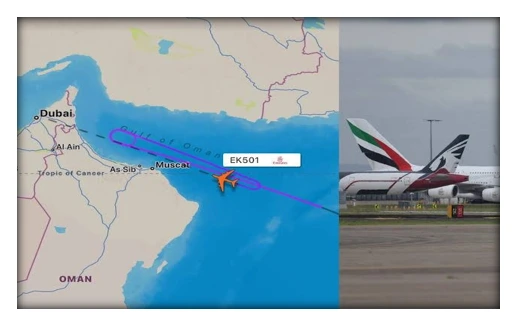
On Tuesday morning, a Mumbai to Dubai Emirates flight (EK501) performed a rare and unusual mid-air manoeuvre of a double reverse due to an incoming missile alert over the airspace in the United Arab Emirates (UAE), according to aviation officials and tracking.
The Airbus A380 aircraft was operating as Emirates’ flagship service from Chhatrapati Shivaji Maharaj International Airport in Mumbai and was approaching Dubai when the UAE’s Ministry of Defence issued a security alert stating that ballistic missiles were being launched from Iran and that air defence systems were now securing the area.
The flight crew initially made a double reverse by flying towards Mumbai to clear out of the restricted airspace as the tactical threat diminished. This was an extremely unusual and bold flight decision and not something done by commercial aircraft.
A double reverse flight refers to the aircraft changing direction back to the original point and then changing direction back to its original intended route. Double revers(es) are typically performed only by military aircraft and are extremely rare for scheduled commercial flights.
Here’s how it unfolded
The airplane was given the go-ahead to fly into UAE airspace when a missile warning went off.
To keep everyone safe, the pilots immediately turned around out of the way of the mortal danger, reportedly heading towards the Indian Subcontinent.
Once they received updated information that the threat was not as serious as originally thought, they made a second U-turn and continued on their initially planned course to Dubai International Airport (DXB).
Flight tracking systems indicated that the plane was temporarily held outside of UAE airspace until the crews and authorities coordinated to ensure a safe ongoing operation for the flight.
Read also: 760 Indian flights to West Asia and other destinations are cancelled
Safe Landing During Ongoing Regional Conflict
Despite the unusual turns that were made in the air, EK501 was able to successfully land at Dubai International Airport and there have not been any reports of injuries or damage to the aircraft.
This incident illustrates how volatile airspace within the region has been due to the increasing level of fighting between the United States, Israel and Iran in the area. The continued testing of ballistic missiles and unmanned drones within the region have prompted many airlines to operate under a heightened state of alert and close down airspace temporarily.
A number of flights have been cancelled in the Middle East over the past few days as many nations have activated their air defence systems and are managing civilian aircraft flying over potentially dangerous airspace. This disruption is had a wider effect on the aviation sector. Among those affected are major agencies worldwide like Emirates and Etihad as well as several of the major domestic carriers based in their home countries.
Major domestic carriers such as IndiGo Airlines and Air India have been forced to suspend and/or divert flights to avoid flying within the restricted airspace established by many governments.
Dubai, Abu Dhabi and Sharjah International Airports have reported some minor damage from debris falling from the sky during air defence interception, and a very limited amount of airport operations have resumed under strict monitoring.
Tens of thousands of passengers are still awaiting repatriation or have been delayed en route to their final destination, but many relief flights are continuing to operate while a significant number of flights are being cancelled on a daily basis.
Many aviation analysts believe that the two-way disruption illustrates the high degree of coordination that is required between the cockpit crews and the relevant air traffic authority/authorities at a time when there are multiple crises occurring at the same time and emphasises that the safety of the passenger will always be the first priority.
