


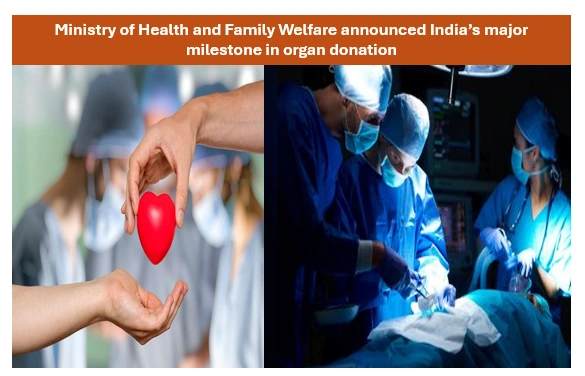
In a move which is considered to be a watershed in India’s health care and the changing social mind set, the country has seen a “historic accomplishment” with organ donation and transplantation, according to Union Ministry of Health and Family Welfare. The number of transplants done a year has jumped to almost 20,000 in 2025 — more than four times fewer than the less than 5,000 recorded in 2013.
This is the one title that we all dread and none of us want to have claimed but no matter how much or hard or solidly I force up pre-recorded voice premayure another episode it has come. Crucially, it underscores a growing culture of “giving” among the Indian middle class and in villages, where bereavement is not just seated in private pain but can be a shared lifeline.
The Statistical Surge: Analysis Beyond the Numbers
The growth is not just the result of more hospitals, but of more hearts warming to the idea of deceased donation. Living donors (mostly relatives donating kidneys or a part of liver) have been the traditional mainstay in India, and deceased donation has begun to take off :
- Total Transplants (2025): About 20,000, compared to 18,911 in 2024.
- Dead Donor Contribution: Dead donor contributions are done in 18% cases, the highest for the country.
- Aadhaar Based Pledges: Over 4.8 lakhs people have pledged their organs on the online platform (both – through the interface and APP) using simplified Adhaar based secure authentication since September, 2023.
- An Emerging Global Leadership: India has emerged as the number one country in hand transplant surgeries, reflecting its world-class surgical skills which were earlier limited to Western countries.
In 2025, over 1,200 families took this brave decision to donate the organs of their deceased relatives — and save lives. Each of these “multi-organ donors” can help save the lives of up to eight people, and give new life to patients with end-stage heart, lung liver and kidney failure.
The Face of Hope: Investigating the Human Spirit Of Renewal
In the last Mann Ki Baat on February 22, 2026, Prime Minister Narendra Modi gave humanity a name and identity when he narrated about Aalin Sherin Abraham’s fight with cancer at just age one from Kerala. Aalin’s parents, Arun and Sherin decided to donate her organs after she Died Making Her One Of The Country’s youngest donors.
These are increasingly common tales. Meanwhile in Delhi, Lakshmi Devi with 15% heart function till her recent transplant was able to complete a 14 kilometer trek to Kedarnath only after she underwent surgery. Gaurang Banerjee of West Bengal has also climbed up to the 14,000-foot Nathula twice post his lung transplant. Not only are these medical miracles but they are the “living proof” of organ donation.
Read also : India’s Opportunity Amid Turkey’s Hair Transplant Boom
Reforms: Construction of the culture “Green Corridor”
The Ministry credits this success to a multi-pronged government strategy that has overhauled the very “plumbing” of the transplant system:
- Green Corridors: The standard operation procedures (SOPs) for ‘Green Corridor’ where routes are cleared for ambulances by the police- or traffic-wing, has come to be a usual day miracle in cities such as Chennai, Hyderabad and Delhi.
- Financial assistance: Poor patients get maximum financial assistance of ₹15 lakh for transplantations through the Rashtriya Arogya Nidhi and they are provided with additional funds of ₹10,000 per month each for post-transplant immunosuppressant drugs.
The Highway to the Future: Crossing Over the 0.81 Boundary
Although there were cheers, the Ministry and health advocates are not out of danger yet. India still has an organ donation rate of around 0.8 donors per million population (pmp). To put that in perspective, Spain tops the world at nearly 48 pmp, and the United States clocks in around 36 pmp.
The “stubborn reality” however, remains that, even as India loses 1.6 lakh people to road accidents every year, only a fraction of these (an estimated 1,100–1,200) are converted into deceased donors. The main obstacles are myths surrounding disfigurement, religious misunderstandings and the absence of specialized “grief counselors” within hospitals.
And as India again edges closer to its ambition of self-sufficiency in high-end health care, that message from the Ministry is clear: The microsurgery works, the surgeons are world caliber, the laws are passed. And the last thing you need to know is the dinner-table conversation — about deciding to be a donor today so that someone else can have a tomorrow.
