


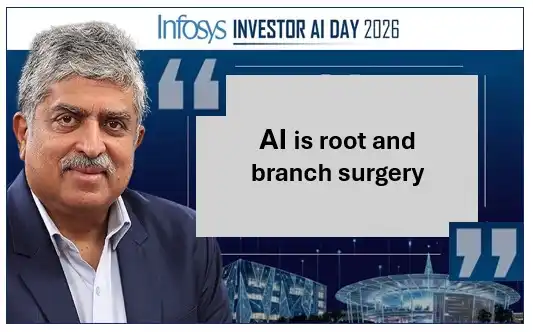
For years, the Indian IT story was a straightforward, deterministic one: a client had an issue, a developer wrote some code and voila! It was a world of linear predictability. It was at the Infosys Investor AI Day in Bengaluru that Nandan Nilekani, architect of Aadhaar and co-founder of Infosys, gave a message putting an end to all that.
AI, Nilekani argues, is more than just a new feature or plug-in for modern business. He called it a “root-and-branch surgery” in the way business is conducted. This isn’t just a cosmetic change; it’s a matter of reworking the corporate nervous system. With the demise of traditional coding and urgency for “legacy clean-up,” Nilekani’s 2026 vision is one of a radical makeover.
The Fall of the (Deterministic) Code Empire, AI Implementation, and What You Can Do About It.One of the strongest takeaways from Nilekani’s speech was his audacious statement that writing code “will no longer be the primary thing we do” for technology professionals. In the past, software was deterministic — A + B always equaled C. AI changes the language of our industry to a non-deterministic world.
The Change from Writing to Orchestrating
In a new paradigm, value is not in the walking and talking; it’s orchestrating what happens.
Prompt over Script: In an AI-native world, the capability to “prompt” a system and control its diverse outputs is more helpful than writing thousands of lines of Java or Python by hand.
The “Orchestrator” Role: On this, Nilekani sings a tribute to what he thinks would be a huge reconfiguration of talent. We’re entering a world where large roles like “QA Testers” and “Front-End Developers” are making way for AI Engineers, Forensic Analysts, and Agent Orchestrators.
Reliability Management: Since artificial intelligence can produce different answers to the same query, this work involves creating “guardrails” and “quality gates,” which are software safeguards or checks to make sure the non-deterministic systems are robust and reliable for use by an enterprise.
Specification: The “Implementation Gap,” and Legacy Debt
Nilekani was swift to highlight a paradox: even though AI technology is advancing at lightning speed, its practical application in the corporate world is still not keeping pace. He refers to this as the “Implementation Gap.”
The “Surgery” on Legacy Systems
AI adoption is “hard stuff” not because the models are brittle, but because they need to sit on something durable and that base is collapsing.
The 80% Problem: Some Fortune 500 companies are spending from 60%-80% of their IT budget just maintaining “legacy systems”—ancient codebases in the sense that they’re built on technology from the late 90s and early 2000s, but more importantly these systems were undocumented and siloed.
Technical debt: A decade of technical debt has built up, and a lot of tech needs the equivalent of a spring clean. To use AI properly, companies will need to undertake “root-and-branch surgery” to clean up this technical debt, break down data silos and modernize their core architecture.
Modernization is No Longer Optional: Nilekani cautioned that companies can no longer wait. The pace of AI adoption is unprecedented — whereas the internet took 10 years to get a billion users, AI is doing so in two. To keep up with this pace, the “cleanup job” has to take place now.
Humanized Impact: 170 Million New Opportunities?
When the overall titan of industry speaks of “surgery” and eliminating “jobs that are going away,” it is only natural to react with anxiety. Nilekani, though, struck a note of mild optimism, calling the present time a “reset opportunity”.
The Nilekani Verdict: The Only Risk is Execution
That message from the chairman of Infosys is clear: There is no “opportunity gap.” The opportunities for expansion and wealth generation of AI dwarf anything we saw with the internet or smartphone.
