


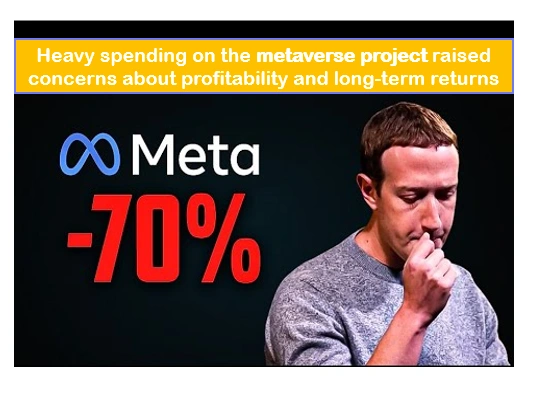
The share price of Meta Platforms Inc., which owns Facebook, Instagram, and WhatsApp, dropped sharply and quickly. It fell about 70% from its recent highs in a short period. The drop has scared investors and served as a stark reminder of how quickly market sentiment can change when people lose faith in big spending plans and growth prospects.
Strong sales, but costs are going up
In recent quarters, Meta’s business showed strong income growth, with sales rising sharply year over year. Advertising remained the main source of income, and the demand for ads grew noticeably. There was a big charge for one-time financial things, like tax changes, though, which sharply cut the stated profits. This led to a strange picture in the reports: sales looked strong, but net earnings looked lower.
At the same time, the company’s costs have risen significantly, especially the capital costs of setting up its technology infrastructure. Many investors didn’t expect these spending plans to change so quickly, which makes it hard to predict how profitable the business will be in the near future.
A huge plan to invest in AI makes people nervous
Meta’s artificial intelligence investments, made too big and too fast, are a big reason for the stock’s sharp drop. The company has said it plans to spend tens of billions of dollars on capital projects, far more than it has in the past. Meta plans to build advanced AI infrastructure, such as huge computer systems, special chips, and research funding that will help lead the development of next generation AI apps.
Long term buyers may see these kinds of investments as looking ahead, but many people in the market are unhappy with the lack of a clear way to make money in the near future. Concerns have been raised that profits could be delayed or come under pressure for several years due to a large increase in planned spending without a clear, monetized product. Because of this, big investors and experts have changed how much they think the company is worth.
The Shadow of Big Investments in the Past
The market’s reaction was also influenced by memories of past investments that didn’t pay off right away. Meta spent a lot of money on virtual and augmented reality technology, which is often called the “metaverse push.” This hurt earnings for years and didn’t bring in money right away. Many investors see similarities between that time and the current large investments in AI, which makes them more worried that the company could make the same mistakes again.
Investors are even more wary because Reality Labs, the company in charge of interactive hardware and metaverse technology, is still losing money even though it is spending money.
Weak Profit Signals Even Though They Beat Expectations
Meta had to deal with both big investment plans and accounting changes that had a big effect on stated profits, even though the company may have made a lot of money in real terms. The top profit per share numbers in the quarterly results were much lower than what the market expected because of one-time tax and accounting charges. If these odd things were taken out of some cases, income would have been closer to what was expected. But buyers usually look at the numbers that are released, and the sharp drop in earnings caused a lot of people to sell.
This shows how headline financial numbers can have a big effect on the market in the short term, even if the business is still doing well on a deeper level.
Uncertainty about new AI products makes people less confident
Meta has been working on a number of big AI projects and models that it thinks will help it grow in the future. But investors are worried because these goods are taking too long to come out, and there aren’t enough details about what they can do or when they will be available.
On the other hand, some competitors have already started making money from AI-powered goods and services, which has helped them keep or raise the value of their stocks even though the market as a whole has been volatile. When Meta said that some of its planned models would need more time to be developed, it raised more questions about when these new technologies might start to bring in big money.
