


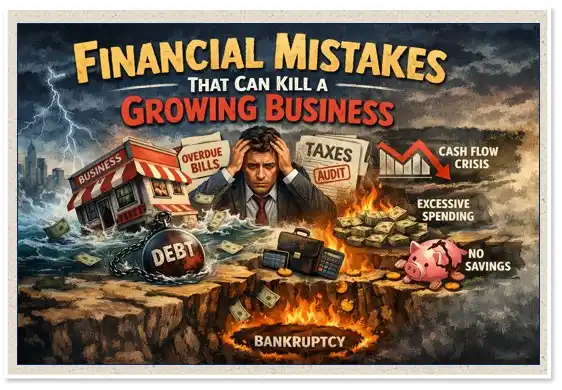
While growth is typically interpreted as evidence that a company is succeeding, there are numerous reasons why a company could fail if they continue to operate without an adequate financial foundation, a framework that would allow for growth while managing finances properly. As the company increases its revenues through growth, the consequences of missing out on a good financial foundation become larger and the ability to correct mistakes is made less accessible. Below are a few examples of financial mistakes that (if made) could ultimately continue to destroy a company that is pursuing relentless development through growth.
Poor Cash Flow Management
Although the company is generating a profit, it may not always have enough cash to meet its obligations. Many businesses fail because they have run out of cash and have been unable to meet their payroll obligations, pay their rent, or pay their suppliers either in full or on time. This can be easily avoided with a Plan for Cash Flow Forecasting; companies that forecast cash flow regularly will have reserves available at all times. It’s important that your company forecasts its cash flow on an ongoing basis.
Too Much Expansion Too Quickly
Growth can be exhilarating for any company; however, if the company’s structure does not support that expansion, it will ultimately create serious problems for the company. If there is inadequate capital to open new locations, enter new markets, and/or increase production levels, the company’s operations may be overwhelmed. Many companies only realize how much it costs to expand until they are actually attempting to complete those costs. The costs to critically assess expansion typically include the following: marketing, staffing, infrastructure, and compliance.
Ignoring Financial Data
Not all entrepreneurs look at numbers, but those who do not review their financial statements, profit margins, and KPIs typically make poor decisions. Therefore, without accurate and up-to-date financial information (like rising costs, lower margins, and unprofitable products), a business owner may not know that these things are an issue until it is too late.
Weak pricing strategy
The 4th type of failure is poor pricing strategies. By underpricing their goods and services to gain customers, many start-ups will eventually fail. In addition to this, they often don’t adjust their pricing to account for the increases imposed by rising costs (overhead, labor, taxes) and growth investments; thus, they will create revenue but lose those profits as well (giving the impression that the company is profitable when really it is not).
7 jobs that Indians never meant to have but now make over ₹1 crore a year
Excessive debt
The 5th failure is too much debt. While debt can help a business grow, it can be deadly if it is not managed properly. There are numerous ways that companies accumulate too much debt (high-interest loans, using a line of credit too much, stacking multiple loans). The result will likely be restricted cash flow and reduced flexibility for the company; furthermore, if the company’s revenue fluctuates, the payments on debt will remain constant (which may lead to a failure risk).
Inefficient energy reserves
The 6th type of failure is insufficient emergency reserves. Unexpected events (recessions, supply chain issues, or significant customer losses) can hit at any time. An owner who does not have emergency funds or reserves will have no way to absorb the shock of these events and will be forced to make desperate decisions (e.g., selling assets, borrowing unreasonably) or closing down that business.7. Mixing Personal and Business Finances
Blurring the line between personal and business money creates confusion, tax problems, and poor financial visibility. It becomes difficult to track performance or plan growth. This mistake also increases legal and tax risks, especially as the business scales and scrutiny increases.
Hiring Without Financial Planning
Hasty hiring and/or hiring individuals before they reach their target output can lead to inflated payroll costs that will quickly exceed fiscal sustainability. All of the company’s compensation and benefits, training, and tax obligations are long-range commitments and should only occur in alignment with the projected future earnings of the company and the projected cash flow that will support these obligations.
Underestimating Taxes
Businesses often fail to account for the effect of the increasing profitability and payroll needs associated with expansion and the additional tax burden that will potentially accompany new locations. In the absence of a proactive tax strategy, a business could face a significant, unforeseen tax bill that could adversely affect cash flow and disrupt operations.
Costly Mistakes from Trying to Save Money by Not Using Advisors
Many entrepreneurs believe they can save money managing their finances without the assistance of an accountant, financial planner, or consultant. There are numerous examples of costly errors that occur simply because an entrepreneur chose not to seek the advice of qualified professionals. In many instances, the value of the advice received far exceeds the cost of the advisory services.
