


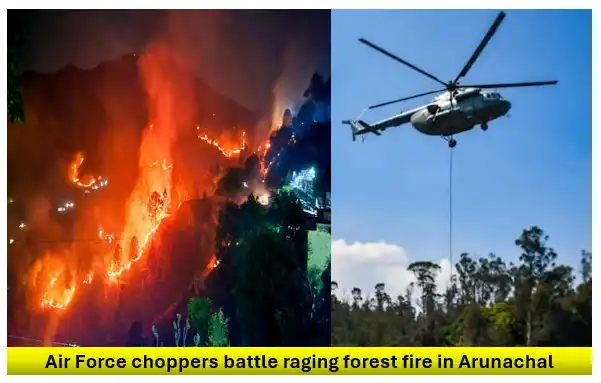
But in the rough-hewed, cloud-tickled swells of India’s eastern Himalayas, the profound quiet of the Lohit Valley was recently pierced by something a bit louder: The steady thumping of Mi-17V5 helicopter engines. The Indian Air Force (IAF) at 9,500 feet The air here is thin and the ground unforgiving, but for the last nineteen days since February 24, when the fire was detected by the IAF contingent stationed at Dharasu in Uttarkashi district of northern state of Uttarakhand) we have been engaged in a high-stakes aerial ballet against a formidable enemy —a brobdingnagian forest fire that has threatened one of India’s most fragile ecosystems.
This is not just a business as usual. It demonstrates the incredible collaboration of technology and human bravery. As flames licked the steep ridges ofAnjaw district, the IAF’s “Air Warriors” jumped in tobattle what ground teams couldn’t—taming a vertical inferno running amok int he rarefied air of upper Himalayas.
The Rarefied Battlefield: Why It Matters at 9,500 Feet
Soaring over a fire at almost 10,000 feet is a logistical and aerodynamic nightmare. For the uninitiated, the technical challenges are daunting:
- Lift vs. Weight: High up in the thin air of high altitudes, helicopter rotors have less “bite.” This diminishes the lift potential of the aircraft and to every litre of water taken there is a delicate balance that must be struck between it and fuel and safety parameters.
- The “Chimney Effect”: Unpredictable wind tunnels are formed over mountainous terrain. The fire’s heat is rising up the steep drainage — driving convective, spinning updrafts that can treat a multi-ton helicopter like it was a leaf tumbling in the wind.
- Inaccesibility: The fire began on the western ridge of the Lohit River, an area marked by jagged cliffs and thick canopy.
Nevertheless, the IAF did spring a surprise by introducing its frontline Mi-17V5 helicopters – the sky workhorse and tailor-made for these rarified conditions.
A Terrorist Precision in the Air, Complete with Octuplets II: The Bambi Bucket Campaign
The IAF fought the fire with the help of the Bambi Bucket system. For those on the ground, it was a cinematic image: an enormous, collapsible orange bucket dangling from under the chopper’s belly, reaching down into local water bodies and then lifting off toward the smoky horizon.
The IAF achieved the following during this surprise operation carried out on January 29 and 30, 2026:
- Dropped 12,000 Litres of Water: Through a sequence of precision sorties, crews were able to deliver targeted “water bombs” onto the hottest part of the fire.
- Contained Spread: The main task was to stop the fire from leaping across ridges into the Lohit-Anjaw belt where there are several small hamlets and biodiversity hotspots.
- Ground Troops Participation: Complementing the bombing campaign were ground troops, part of the Spear Corps of the Indian Army who in conjunction with IAF attacked from above through “fire lines” (wherein strips of land are made devoid of any inflammable material so as to cutoff fire’s fuel source).
The IAF called the mission a display of “exceptional courage and precision,” with potential for catastrophe if there was merely “one error of judgment” in the wind-swept Himalayas.
Also read:
- Nidhi Nagori Speaks Out Against Anti-India Hate Abroad
- Death toll in Kolkata warehouse in Anandapur
- Goa Nightclub Fire Case Widens
Protecting the “Fragile Green”: Ecological Concerns
Arunachal Pradesh is also known as the ”Amazon of the East.” The Lohit Valley, for instance, is home to unique flora and fauna can be found nowhere else. At this altitude, a forest fire isn’t just about burning trees; it burns the topsoil, causes ash loads that cause landslides during monsoon and wipes out nesting grounds of high-altitude birds.
Forest officials in the area said the winter of 2025-26 was particularly dry. With the high-speed winds of the Eastern Himalayas, it turned into a firestorm on the floor of the forest lined with dry pine needles and leaves.
“The air support worked as a game changer,” said a local forest official. “Had it not been for the IAF, The fire would have spread to the lower valleys and habitations in two days.
The Human Element Courage at the Controls
Behind the technical terms like “sorties” and “payloads,” are the pilots and crew who fly into the smoke. Visibility at 9,500 ft was close to zero in a forest fire. Pilots must rely on a mixture of instruments and intuition, skimming perilously down the side of the mountain to release their water drop at just the right time.
A Coordinated Victory
Its enormity could easily be seen throughout Islamabad, and by the evening of January 30, firefighters managed to put out most of the fire. Though “hotspots” still exist and foresters are watching the area for flare-ups, the immediate danger to life and property has been averted.
This victorious operation is an example of the Jointness of the Indian Armed Forces. The Army gave the ground intelligence and containment, while Air Force did the “heavy lifting” needed to put out the fires. It is a potent reminder that against Nature’s fury, the state bureaucracy and military will remain India’s first line of defence.
