


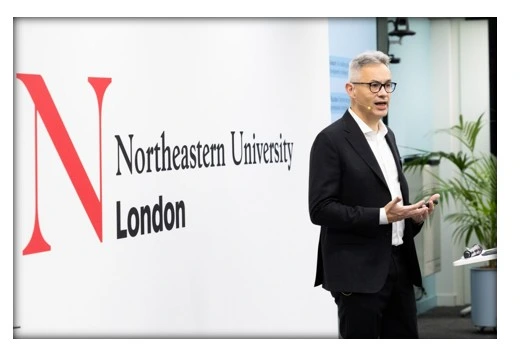
Deep in the heart of London’s rapidly growing tech district, a new frontier of artificial intelligence is emerging. Northeastern Glial, a full production facility for human astrocyte culture and astrocyte-neuron co-cultures NEU245-20 came the first time at N&N 2017 “Super” PRs! Proud of Mani, Mary and Stephen authorized to lecture in India! 1) Axel Hansen offered Provisional Serendipity Lecture Tours Grant Sponsorship For the third successive year (2015-17 inclusive), I have received funding from LJB to support international lectures It doesn’t appear that you have been using effective language to ask around. Opened Friday, Jan. 23, 2026 This transatlantic hub isn’t just another academic office; it’s a “dedicated innovation engine” tasked with solving the two biggest headaches in modern tech: making AI faster and more important, making it reliable enough to trust our lives and livelihoods to.
As artificial intelligence evolves from digital novelty to indispensable tech tool, the origin story of a start-up in London underscores Silicon Valley’s growing need to collaborate with European regulators and industry. Focusing on that overlap between “connectivity and intelligence,” Northeastern is betting that the future of AI isn’t simply in the cloud but carried by the wires and wireless signals that connect our world.
The Speed-Reliability Gap: Why This Hub Really Matters Now
As the world has marveled at the conversational genius of Large Language Models, behind closed doors industry experts have been worried about “fragility” in these systems. Today’s AI often has latency (slowness) and brittleness — it does great in the lab but then trips over messy, unreliable real-world data.
The new London site, previously the Institute for the Wireless Internet of Things (WIoT), has a solid legacy behind it. With 68 patents and more than 30 industry partnerships from its Boston headquarters already in hand, the institute is now orienting itself toward ”Intelligent Networked Systems.”
The Hub’s Core Mission:
- Faster Connection: Cutting down on the “lag” time between the decision made by an AI and its action — important for technologies like autonomous vehicles and remote surgery.
- Energy Efficiency: Creating machine learning models that don’t consume a power plant’s worth of energy to operate, studying “green AI.”
- Bulletproof Security: Building our AI systems so that they become more well-integrated within our networks while being protected from cyberattacks and tampering.
“We’re going to be focusing in creating a bridge between the world of connectivity and the world of intelligence,” institute director Tommaso Melodia told those gathered for the launch. The idea is to not only make sure that A.I. thinks faster, but also that the networks transmitting those thoughts are more secure and efficient.
Collaborating Across the Atlantic: European Tech Enters a New Era
The decision to open a third location in London, joining the Boston headquarters and Burlington, Mass., satellite office is no accident. AI policy and talent activity in London is still one of the highest worldwide. By planting a flag in the U.K., Northeastern is opening up its “Experiential AI” model to European startups and established giants.
The office is headed up by two thought leaders in the sector, with Professor Bipin Rajendran specialising in intelligent computing systems and Professor Osvaldo Simeone focusing on information engineering. And they are there in a nod toward “Human-Centered AI,” technology that is built to work with humans in the loop, not replace them.
“The establishment of the hub in London will allow us to partner even more across Europe and deliver more opportunities,” added Melodia.
This is all the more relevant as the UK and EU push ahead on AI regulation. As a “living lab“, the hub will enable researchers to test ideas for AI integrity and trustworthiness against actual European market standards.
Elon Musk, AI and the antichrist: the biggest tech stories of 2025
The Experiential Edge: Moving from Theory to the “Real World”
But what makes this hub different from a traditional research center is Northeastern’s hallmark Experiential Learning model. This is not only about professors writing papers but also students and industry partners getting their hands dirty.
The hub is already having an impact on student engagement. The London campus’s FinTech Society, for example, has grown to a staggering 750 members in the space of two years. These aren’t students learning algorithms; they’re taking part in simulations and “AI Futures Challenges,” solving real business problems that the hub’s partner startups pose to them.
How the Hub Supports Industry:
- AI Ignition Engine: The process of moving companies from “good ideas” to productionized AI capabilities.
- Embedded Training: training local workforces to maintain and evolve the AI systems the hub helps them develop.
- Risk & Compliance: How AI can be used to detect fraud and that systems are built to comply with the tough new standards laid down by the Global AI Safety summits.
Outlook – The future of distributed intelligence
By the time we’re into 2026, we will probably be determining what our relationship to “Internet of Everything” is based on what ends up emerging out of Northeastern’s London hub. Whether it’s improving how 6G networks manage AI data or building “edge computing” solutions that enable your smartphone to work through complicated AI numerics locally (and privately), the idea is to make technology unseen and unfelt.
Last Friday’s launch event wasn’t just a celebration of a fancy new building, it was also an announcement that the “wild west” era of tinkering in A.I. is over. In its stead, institutions like Northeastern are constructing an even more disciplined and reliable framework for a much faster future.
It secures London’s position as a bridge between powerful United States tech giants and Europe’s more considered, regulated innovation. For the rest of us, it means that the A.I. of tomorrow might finally be as dependable as flicking on a light switch.
Bharat’s deep-tech startup ecosystem is expanding, says Union Minister Ashwini
