


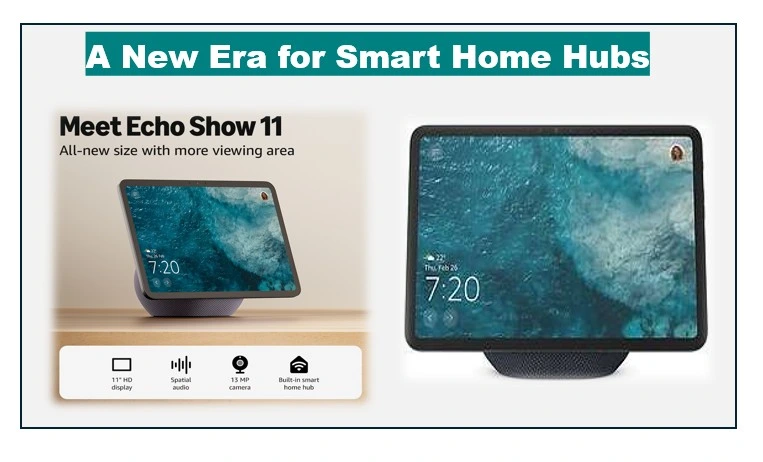
The shape of the “connected home” changed dramatically. Amazon introduced the Echo Show 11, a device that pushes its role as merely a smart screen into becoming an active hub for today’s home. Debuting Jan. 20, 2026, the Echo Show 11 brings with it a more subtle version of AI that Amazon wants to manage your life for you without needing to be asked.
The Heart of a Modern House: Try the Echo Show 11
The Echo Show 11 isn’t just a larger version of those models — in fact, it offers a fresh take on what a tabletop smart display can or should be. Its 11-inch Full HD (1,920×1,200) edge-to-edge glass display is a compromise between the compact Echo Show 8 and the enormous Echo Show 15 and 21 that you can mount on the wall.
The design is also more streamlined, with much slimmer bezels and a high-quality 3D-knit fabric base that makes it not an eyesore in living rooms or kitchens. But, the true “magic” is under the hood. With new AZ3 Pro custom silicon at its core, Echo Show 11 is designed from the ground up to meet the needs of Alexa+, Amazon’s next generation generative AI assistant. This chip lets it handle faster processing, more natural conversation and the ability to carry out complex, multi-step requests that would’ve stumped older models.
Omnisense RISE / High AI Ambient Levels
The most impressive upgrade in the Echo Show 11 is probably Omnisense, a new sensor platform meant to cover “the next generation of proactive functions.” For the longest time, smart homes worked in a reactive way – you had to tell Alexa to turn on the lights. Omnisense changes that dynamic.
By combining the 13MP camera’s images with ultrasound, Wi-Fi Radar and computer-vision processing, the device is able to detect presence and movements with incredible precision. Picture the Echo Show 11 recognizing you walk in to your kitchen each morning, pulling up just your calendar (not a shared one) informing how long it will take you to get to work and turning on the lights — without being asked.
These sensors also enable
- Temperature-Driven Regimens: Fans or smart thermostats that automatically turn on when a room reaches certain temperature.
- Personalized Greetings: Using Visual ID to know which family member is on their way and showing them only their alerts instead of a general feed.
- Safety Monitoring – Utilize “Wi-Fi CSI” (Channel State Information) to detect abnormal movement patterns or falls; discreet tool for elder care.
A New Benchmark for Sound and Vision
Amazon hasn’t overlooked the “Show” part of the device. It also has an all-new audio architecture with the Echo Show 11. It uses frOntfiring stereo speakers and a dedicated custom woofer for its sound profile that supports Spatial Audio. This means it’s now an excellent standalone speaker for music streaming services such as Spotify and Apple Music, with deep bass and clear vocals that compete (prominently) with mid-range dedicated speakers.
Video calling has received a significant boost as well. The 13MP camera has been updated with a more centered auto-framing and 3x zoom mode so that you never leave the shot, no matter how active you are in the kitchen making dinner. With smart AI noise reduction technology (AZ3 Pro chip), it can also filter background noise like clanging pots while, let your voice comes through crystal and clear.
The Privacy Trade-off
As with any product that relies on “ambient sensing,” privacy is a central question. Amazon has tried to address this worry by adding a physical microphone and camera shut off switch on the side of the device. It doesn’t have a sliding physical shutter like the Echo Show 10, but again: The “hard switch” is electronically disabling internal hardware. Users can also see and remove their voice recordings and visual data from an Alexa Privacy Hub.
Why It’s the “Era of the Hub”?
The Echo Show 11 is a pivot away from “gadgetry” and toward “infrastructure.” It is also a Matter and Thread controller, meaning that it can aggregate things from all manner of companies—Apple’s or Google’s, Samsung’s — under one unified interface.
The smart home is no longer a matter of novelty, as we see on the cusp of 2026; it’s about what wonkier tech types call reducing the “cognitive load” of life. By combining security feeds (up to four cameras at once), family calendars and proactive automation into a single, sleek 11-inch screen, Amazon is betting that we’re ready for a home that will anticipate our needs before we’ve even thought of having them.
