


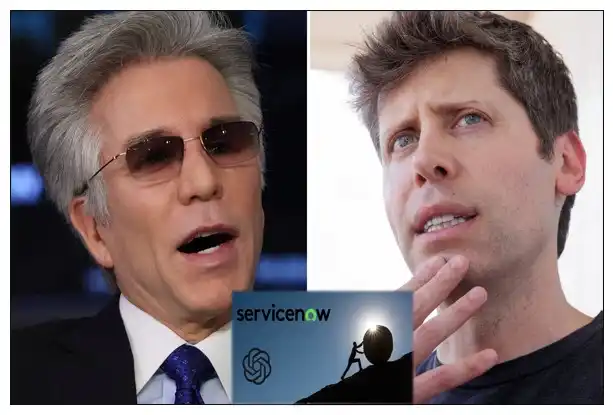
The business community has gotten past the time when “chatbot” was king, and algorithms could prove themselves self-executing. The announcement On January 20th, 2026 ServiceNow, the digital backbone for 85% of the Fortune 500 will partner with OpenAI on a new multi-year relationship. This’s not a licensing relationship, it’s a deep structural integration designed to bake OpenAI’s latest-and-greatest models—of which the newly unveiled GPT-5 is just one—right into Microsoft’s cloud. 2 — straight into the 80 billion workflows underpinning global commerce.
As corporations grapple with “AI fatigue” and the disconnect between pilots and real ROI, this collaboration offers a vision of a “no bespoke development” future, where AI is not just a suggestion-giver but a doer.
The AGENTIC ENTERPRISE, Who Knew? Out of “Helpful Suggestions”
For the last two years, enterprise AI has mostly been a smart librarian: summarizing long threads, drafting emails or handling primitive HR queries. The ServiceNow-OpenAI alliance is a sign that we are entering an era of Agentic AI. This new paradigm is transforming AI into a proactive “teammate” that can handle end-to-end tasks securely through the company’s infrastructure.
This is ServiceNow’s President and COO Amit Zavery putting it as a transition from the “experimentation to execution for cloud computing”. ServiceNow integrates OpenAI’s latest technology directly into the Now Platform, providing ServiceNow agents with cognitive “horsepower” to keep pace with complex enterprise logic. Be it getting a new employee set up, dealing with a major server or data center outage or resolving invoices between global supply chain partners, these agents now have the ability to reason across departments—IT, HR, Finance and Legal—and close cases on their own.
Real Time Speech: Breaking the Sound Barrier in CX
The most human-related achievement in this collaboration is probably the introduction of native speech-to-speech AI agents. For now, most voice AI operates in a “cascading” manner: It listens to a human, transcribes that speech into text processes it through some model and then translates the output back into spoken words. This naturally creates a robotic ‘lag’ which can disrupt the flow of a conversation.
ServiceNow and OpenAI are creating agents that work directly in audio. This allows for:
- No-Latency Interactions: A customer can speak their language of choice and get an instant, natural response.
- Contextual Nuance: By hearing audio instead, the AI can make a better sense of tone, urgency and emotion you find in text translation get flattened out.
- Instant Orchestration – the AI can be opening a service ticket, kicking off an internal approval and updating someone’s record while it is speaking vs. having a human have to log into their CRM system after a call with “after call work”.
Computer-Use Models: Automating the “Un-automatable”
One of the lingering headaches for big companies are “legacy silos” — old software platforms, mainframes or custom-built applications that don’t have modern APIs. These have historically been the graveyard of automation efforts, because machines could not “talk” to them.
Artificial intelligence company OpenAI is porting the AI models it uses for Parkinson’s law, Diamond and other programs to the ServiceNow platform. This is what enables AI agents to “see” a computer screen and use it like a human worker: clicking buttons, typing into legacy terminal fields, or moving through old-school screens. This power is, functionally speaking, the “API-fication” of an entire enterprise, giving ServiceNow the ability to orchestrate work across every piece of software a company owns no matter how old it might be.
The AI Control Problem: Sovereignty in a World of Autonomous Agents
The feared AI of any CIO in 2026 isn’t so much the one that has gone rogue as the one that goes rogue, committing a billion-dollar error or accessing secure information without authorization. To address this, ServiceNow is presenting itself as the AI Control Tower for Business Reinvention.
The collaboration brings in a robust governance layer that serves as a kind of “single pane of glass” for AI oversight. As these OpenAI agents increasingly take full end-to-end actions the Control Tower offers:
- Auditable Logic: A full “paper trail” for why an AI agent did what it did, so that decisions are transparent and reversable.
- Safety Guardrails: With the Now Assist Guardian, organizations can put in place guardrails to block content on controversial topics, protect against prompt-injection attacks and enforce that AI agents adhere to role-based access controls currently in place.
- Visibility of Consumption – Because the agreement includes a revenue commitment from ServiceNow to OpenAI that is tied to usage, it gives companies visibility into their AI ROI in real-time and enables them to see which agents are providing the most ROA.
A Strategic Tack for ServiceNow and OpenAI
This is an important deal. For ServiceNow, it is both a defensive and an offensive masterstroke. The company is under pressure to show it can hit its $1 billion “Now Assist” sales target by the end of the year after a rocky start to 2026. By making OpenAI its “preferred intelligence,” it saves the insane R&D costs of creating their own frontier models, and offers customers the world’s best AI conceptually ‘out of the box’.
The deal is a huge validation for OpenAI of its enterprise strategy. Consumer subscriptions to ChatGPT are a rich revenue stream, but the real “gold” is in being the code embedded inside the plumbing of the global economy. With the ServiceNow partnership, OpenAI can guarantee its technology is deployed in the most secure and high-stakes scenarios — think Morgan Stanley, PayPal and Walmart — where reliability is a must.
The Rise of the Autonomous Enterprise will Redefine Business in 2026
The Human Factor: Taking Back the 40-Hour Work Week
At heart, the union between ServiceNow and OpenAI is a wager on human capability. By shifting the “administrative friction” — soul-crushing scut work like hunting down information in musty old systems, harassing people for approvals or updating systems manually — through autonomous agents, the goal is to give humans more time.
CEO Bill McDermott has championed the idea that “AI won’t replace enterprise software — it will be being the engine of a new era of productivity.” By the second half of 2026, success for this partnership won’t be measured in stock prices or revenue commitments; it will instead be based on whether we finally make good on the decades-old promise of a “paperless, frictionless” office.
For today’s worker, that might mean never having to fill out a form or search a portal the next time you need to file an expense report or request a new laptop. You will just talk, and the work is accomplished.
