


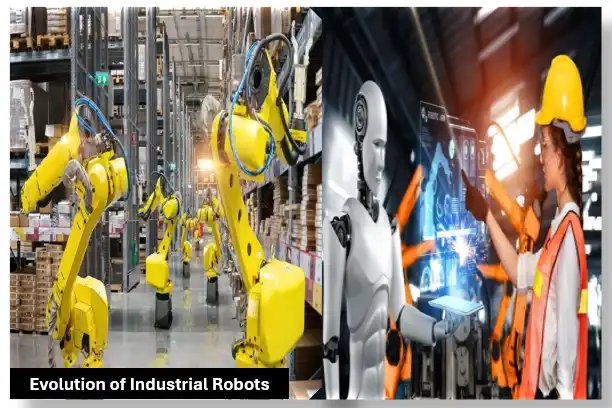
Industrial robotics is progressing at such a pace that it is changing the face of the labor force all around the world. Industrial robots were only used for repetitive work in car assembly plants, but today these robots are being increasingly employed in all sectors of industry, from healthcare to construction. Robots, thanks to their continued development based on artificial intelligence, are increasingly autonomous, collaborative, and intelligent, and all this is changing the face of the world of work.
Evolution of Industrial Robots
Industrial robots have come a long way in terms of improvements in the levels of their earlier versions. Conventional robots were able to follow predetermined tasks that were repetitive in nature and took place in a controlled setting. However, modern robots are more intelligent and versatile. Collaborative robots, or cobots, are safe to work alongside, while AI robots are capable of adapting to constantly varying situations in real-time.
Impact on Employment and Job Roles
Industrial robots are widely discussed in terms of their effect on the workforce. This is because robots are capable of replacing human labor in tasks where the work is repetitive, dangerous, or physically strenuous. Such tasks include assembly line employees, machine operators, and warehouse handlers.
However, industrial robots are not only job-displacing but also job transformers. Even as certain classical jobs are reduced, new jobs are also being created, such as robot technicians, automation engineers, data analysts, and artificial intelligence specialists. The forthcoming workforce would largely involve activities requiring creativity, problem-solving, emotional intelligence, and complex decision-making, which would remain the domain of humans.
AI now consumes more water than the global bottled water industry
Human-Robot Collaboration
The future of work is about a partnership between human beings and robots – working together as a team. By working alongside robots, organizations can leverage the capabilities of human judgment and flexibility as well as the precision of robots. Robots work alongside workers by assisting them in tasks ranging from handling heavy payloads to working in a danger zone.
This partnership increases productivity and work quality. Employees can move or transition from manual or physical work roles to management, analytical, or creative jobs. With more intuitive interfaces—either voice commands, gestures, or visuals—robots can be used even by those who are not technically competent individuals.
Skills and Workforce Transformation
The rise of industrial robots requires a significant upgrade in the skill sets of the workforce. While traditional skills such as robotics programming, systems integration, data analysis, and information security are taking prominence, another set of required skill sets includes flexibility, teamwork, critical thinking, and lifelong learning.
It is essential that organizations and governments invest in reskilling and upskilling programs to be able to support workers during this transition. The new era will come where lifelong learning is the reality, and workers are continually upskilling to keep up with the change that is being driven by technology. Institutions, too, have to change their way of teaching to be based on automation sectors.
The Rise of the Autonomous Enterprise will Redefine Business in 2026
Productivity, Efficiency, and Economic Growth
Industrial robots can drastically enhance productivity, quality, and efficiency in production. Because they work around the clock, they minimize errors and waste while producing high-volume outputs with consistency. This results in cost reductions in production, enabling firms to be more competitive. At the macro level, such automation may contribute to economic growth, restoring of manufacturing, and the strengthening of supply chains.
SMEs are also starting to benefit from more affordable and flexible robotic solutions, democratizing access to automation and allowing innovation in various industries.
Ethical, Social, and Regulatory Challenges
Despite advantages, there are serious ethical and social issues caused by the widespread use of industrial robots. Unless automation is responsibly managed, the risk of job loss, income inequality, and workforce polarization is real. There are also associated concerns with data privacy, algorithmic bias, and worker surveillance through smart robotic systems.
Governments and institutions need to provide a proper framework to support good labor practices and robotics usage in a socially responsible manner. Social support systems and collaboration between public and private institutions will be vital in ensuring shared gains in technology like automation.
Conclusion
The future of employment in industrial robots is complicated and in a state of flux. The fact of the matter is that industrial robots will both displace various jobs and present new avenues, as well as boost production and secure the work environment too. The solution for a favorable future for industrial robots and employment, hence, depends upon the involvement in human–robot collaboration, investment in training, and response to social and ethical issues.
