


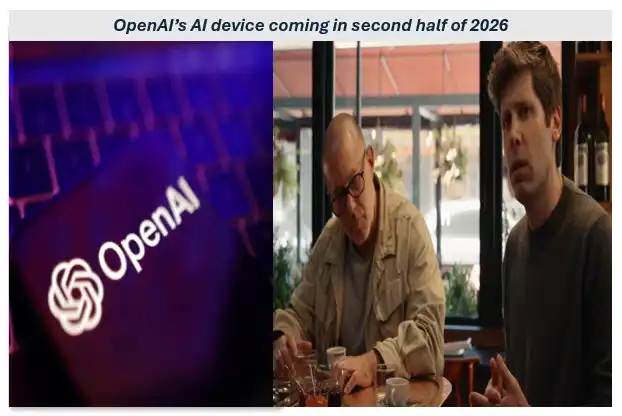
The long-rumored “stealth” partnership between OpenAI and the legendary former head of Apple design Jony Ive has moved beyond pure speculation. While the rest of the world is still trying to figure out how it feels about AI being slowly absorbed into our screens, OpenAI is doing everything in its power to totally shatter that glass. OpenAI Policy chief Chris Lehane said during the house_work=davos2026-axio openai’ Axios House Davos event in January 2026 that the company is “on pace” to deliver its inaugural hardware product some time during the latter half of this year.
This is a high-risk roll of the dice to redefine what personal computing will work like. In something of a partnership between the silicon valley optimism of Sam Altman and the relentless aesthetic exactitude that carried iPhone man to prominence, OpenAI is seeking to create what Altman describes as a “peaceful” and “shockingly simple” alternative to today’s smartphone.
Recruiting the Apple “A-Team”
It is this radical vision that Ive has begun to bring to life, and he’s been doing so with a vengeance: raiding his former employer’s talent pool. The latest high-profile hire is Janum Trivedi, a former Apple engineer and interface designer.
Trivedi is not just any hire: he was an instrumental figure in the development of iPadOS — the person behind some of its defining features such as Split View, multitasking Drag & Drop and iPad Pointer Gestures. His skill at designing fluid, intuitive methods of interacting with complex software is considered a crucial skill for a device that reportedly doesn’t have a traditional screen.
The Growth of the “io” Team
The hardware division, informally called the “io” team (or OpenAI x LoveFrom), now includes at least 25 former Apple employees. This roster includes:
- Tang Tan: Former Apple executive responsible for design of the iPhone and Apple Watch, he is now serving as OpenAI’s Chief Hardware Officer.
- Cyrus Daniel Irani A longtime Siri interface designer.
- Matt Theobald: For 17 years, he was part of Apple’s manufacturing design team.
This talent concentration is the clearest signal yet that OpenAI isn’t just cooking up a gadget; they’re trying to reproduce the hardware-software “mind-meld” that turned Apple into the world’s most valuable company.
Form Factor – Screenless, Ambient, Peaceful
What will that actual device look like? Though the team has tested a number of prototypes spanning from smart glasses to digital voice recorders, current news and leaks point toward an audio sidekick that operates sans screen.
Altman has often suggested that the device is going to be “ambiently aware,” using microphones, and possibly cameras, to get a sense of an user’s environment, offering context-heavy assistance without a glowing rectangle in front of a person’s face.
Speculated Designs:
- The “Sweetpea” Concept: Rumors point at a wearable ear-worn AI companion that may complement or replace standard earbuds such as AirPods.
- The “Third Core Device”: Altman has referred to the as-yet-unreleased product as a “third device” that you carry around with a laptop and a phone (about the size of an iPod Shuffle), which could be something like a smart pen or a wearable pin-like device.
Now, the idea is to get away from that “extractive” nature of social-media-heavy smartphones and go with a more “human-centric” interface where voice and sound are the primary means of control.
The Supply Chain: Moving to Foxconn
Strategic moves are playing out further away from the public eye in the supply chain as well. Initially, the project was reported to be made in collaboration with Luxshare but a newer excerpt from early 2026 indicates that OpenAI might also put Foxconn’s manufacturing prowess into good use.
The shift is part of a broader push to diversify production beyond mainland China, with assembly in Vietnam or the United States. Snagging the OpenAI hardware contract is a big victory for Foxconn, setting it up as perhaps the primary partner for AI computing in both the cloud (servers) and at the edge (consumer devices).
Can OpenAI Leapfrog the iPhone?
The stakes for 2026 are higher than high. For OpenAI, it’s a “leapfrog” move — an effort to get ahead of the gatekeepers of the App Store and control hardware for AI in an era when, it hopes, these are not just competing with one another but also changing everything else. For Jony Ive, it is an opportunity to demonstrate that his design philosophy can still shape the next 20 years of technology — just as it has defined the past 20.
Policy Chief Chris Lehane told us that even though the unveil is targeted for late 2026, the team is still being careful. They are seeking “delight and wonder” time, not a frenzied product launch. If they succeed, our interaction with technology might one day be as seamless as having a conversation.
