


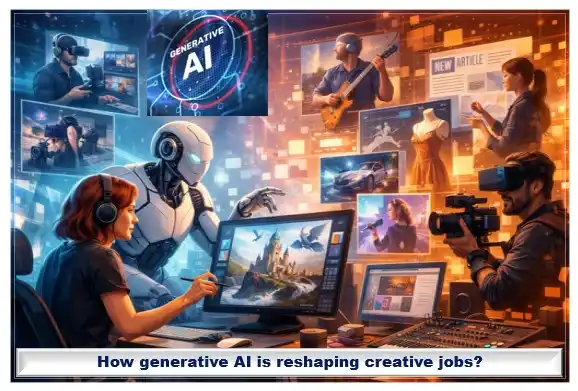
The creative industry of text, image, music, video, and code generation is experiencing revolutionary change at an unprecedented pace because of generative AI. ChatGPT, Midjourney, DALL·E, Runway, and Suno are already mainstream and integrated components of creative workflows, and generative AI not only performs tasks but also redefines the role of a creative professional.
Evolution from Manual Creation to AI-Assisted Creativity
The traditional processes followed by creative work were highly dependent on the efforts of human imagination and skills. The emergence of Generative AI has changed all these by using it as a partner in creativity. The use of Generative AI assists writers in generating articles, developing concepts, and improving language skills. Designs now take seconds to be produced by the designers in the place of days. Musicians also use melodies produced by the use of AI.
It doesn’t go against creativity but rather multiplies it. It merely implies that instead of devoting time to groundwork, artists will devote less time to it and more to conceptualization and polishing. Creativity is shifting from execution-oriented tasks to idea-oriented tasks.
Changing Skill Requirements in Creative Roles
With the rising popularity of AI technology, the skills that creative professionals should have are shifting. They are no longer required to know skills such as brushwork techniques, cameras, or musical instruments. Today, creative professionals are supposed to know skills such as:
Use of the skills in designing question prompts to guide the outputs of artificial intelligence systems in creating positive.
Skills for Critical Judgment in Editing AI Content
- Critical judgment to edit the content produced by AI systems
- Conceptual and Strategic Thinking to Determine Creative Direction
- Knowledge of ethical issues in originality, bias, and intellectual property
Therefore, in this new setting, being able to ask effective questions of an AI may be just as important as being artistic.
New Creative Roles and Opportunities
“The potential of generative AI technology is not only to change the nature of many types of work but to bring into existence entirely new occupations.”
Strategic thinkers for AI content, who developed a workflow that fused human and AI creativity
Additionally, the new normals within the industry have evolved to the point where solo artists and small enterprises can fairly interact with larger enterprises
Disruption & Job Insecurity Concerns
However, there is a concern over job replacement by generative AI systems. Junior jobs such as junior designers, basic copywriters, and production assistants are easily replaceable by AI because they involve repetition that is done by AI very effectively.
However, history has proved that there exists a trend in which the appearance of technology always leads to an adjustment of roles, rather than eliminating the roles in their entirety. The printing press, camera in the realm of photography, or even the digital image edition process in the creative sector influenced roles, yet enhanced the potential of the said roles.
Generative AI clouds the issue of existing notions of authorship and originality. How does an image created by an AI from two million images belong to whom? What constitutes creativity? Is it creation, selection, or intention?
Such problems have also begun to pose a challenge to various industries with respect to laws of intellectual property rights, credits, as well as creative values. Currently, many organizations have also turned their focus to human-in-the-loop methods and have also begun to view AI as a tool or a machine, instead of a creative entity on their own.
Productivity Gains and Creative Experimentation
One of the most striking aspects of the use of Generative AI applications is the impact it has had on our capabilities as producers. Whereas what was possible in weeks could now be done in hours in terms of storyboarding, mock-ups, or even musical concepts.
Creatives can experiment with several styles, formats, and tales with relatively low costs incurred. Indeed, this provides an element of compressing innovation timelines.
While AI machines excel at pattern recognition and mimicry, these machines lack “experience,” “emotions,” or “cultural context.” The creativity of human beings comes from “empathy,” “intuition,” and “semantic”.
The most successful creative people will be those who are best at combining human insight with efficiency delivered by AI. Areas like storytelling, human emotion, judgment, and sensitivity are ones in which human beings have a clear advantage.
Conclusion: Complementing, Not Replacing
The future of creative employment is not shaped by AI, but rather it’s an engine of transformation. Indeed, AI may well displace some kinds of creativity, but there’ll be many new forms that will emerge.
“The future of creative work is a collaboration between humans and machines,” whereby the scale and velocity of the work can be done by the machine, while the vision, purpose, and meaning can only be provided by humans.
