


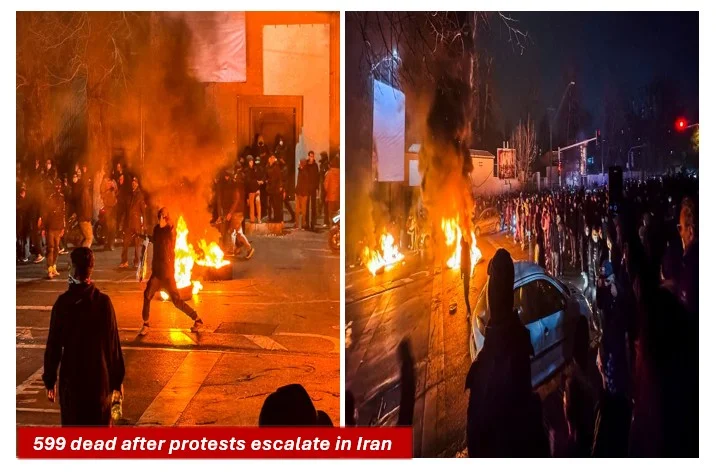
The winter nights of Iran have become even darker, lighted only by the flicker of street fires and the strobe lights of security forces. Tuesday 13th January 2026 The human toll of the national uprising has climbed dramatically to reach a new high. Human rights monitors and activist networks have now verified the killing of at least 599 people since unrest began late last year, though some local nongovernmental organizations fear that the true figure could be much higher.
What began as a protest against the collapse of Iranian rial (it fell to more than 1.4m to the dollar) quickly became the most serious challenge to the clerical government for many years. The streets of Tehran, Kermanshah and Esfahan are the frontlines in a battle for the country’s soul as this “Year of Blood” marches on.
The Human Cost Beyond the Numbers
The number 599 is not a mere statistic; it speaks to a broad section of the nation in mourning. At least 496 protesters and civilians were killed, alongside around 48 security forces, according to the U.S.-based news organization Human Rights Activists News Agency (HRANA). The violence has not spared the young – there have been reports of minors being recognised by their families at morgues on the fringes of the capital.
As the information blackout approaches its 100th hour, power continues to be out at almost all places where people can go online. With fixed-line and mobile data cut, the government has created an information vacuum. Activists suspect an “internet iron curtain” is in place to conceal the full extent of the crackdown. But chilling video footage keeps surfacing, with images of packed forensic centers and families imploring the return of their loved ones’ bodies — at times under threat of “secret” deaths if families don’t cooperate with government narratives.
Iran Says It Launched Three Satellites Into Space From Russia
A Show of Force and Defiance
To counter the growing insurrection, the government held massive pro-government rallies throughout the country yesterday. State television broadcasted tens of thousands in Tehran’s Enghelab Square shouting slogans against “American-Zionist terrorism.” Speaking to the crowd, 86-year-old Supreme Leader Ayatollah Ali Khamenei lauded the number of people who turned out — despite a cold and rainy morning – as a “warning” for foreign foes, especially the United States.
But the “official” show of force has had scant effect at squelching an undercurrent of rage over a sickly economy and systematic repression. And while government officials said they have the situation “under total control,” reports of nightly battles in working class suburbs paint a different picture. The wall of fear that has supported the clerical rule for nearly half a century seems to be crumbling under the weight of extraordinary economic despair.
U.S. President warns of 25% tariff on countries doing business with Iran
The Trump Ultimatum: Tariffs and ‘Red lines’
The crisis has now become internationalised. AP) — President Donald Trump has delivered a series of warnings to Tehran. In a surprise to the world markets, the President announced a global 25 percent tariff rate on any country (including key players like China and India) that maintains trade with Iran.
“The red line is in the rearview mirror,” U.S. officials said, indicating that the White House was considering options for military strikes along with economic and diplomatic measures.
Vice President J.D. Vance and Secretary of State Marco Rubio may be laying out a “suite of options” that includes diplomacy, but the President has warned that he “may have to act” before any formal talks. For its part, the Foreign Ministry in Tehran has indicated that it remains “open to diplomacy” so long as those talks are not “one-sided and based on dictation.”
The Strategic Stalemate
Iran finds itself in a perilous state of inertia as the middle of January 2026 looms.
On the ground: Protesters are reportedly turning to Elon Musk’s Starlink to circumvent the blackout and coordinate, while security forces have increasingly turned from police suppression into what some describe as “open warfare” against civilians.
In the economy: The rial’s collapse has become a form of collective punishment, making basic goods unaffordable — further stoking the fires of the protests at a time when it is also being accused by the state of bringing misery to the country through international sanctions.
Around the world: The European Parliament has banned members of the regime from its doors, and the United Nations secretary general has registered “shock” at the use of deadly force.
Conclusion: A Nation on the Verge
The rebellion is no longer one over the price of fuel or the value of a currency; it is about the right to a future. With the death toll careening toward 600 and the United States threatening economic and military intervention, the days to come will very likely be some of the most momentous in Iran’s modern history. The outside world’s most pressing question is whether the “Year of Blood” brings in a new age of freedom or plunges some portion of its already battered land even deeper into unrest.
