


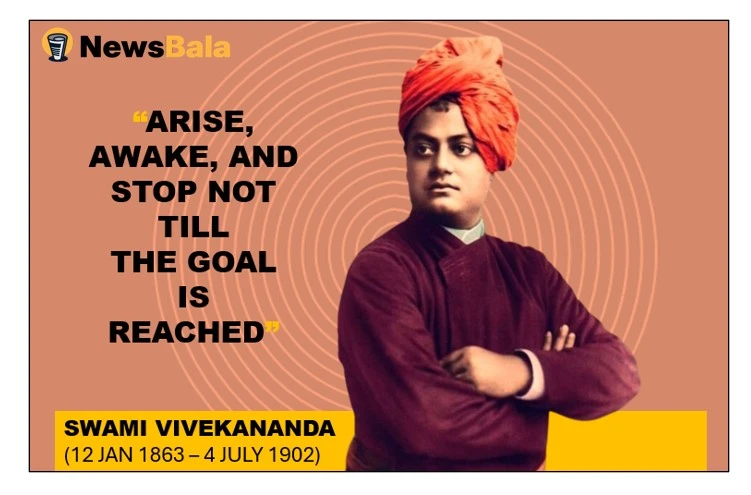
Thanks to digital silos and self-absorbed ambitions, in an increasingly atomised world the issue of “how to care for others” can come across as one more moral imposition interrupting our glorious journey towards the realisation of individual desires. But the 19th-century philosopher-monk Swami Vivekananda gave us a blueprint that turns ethics into not rules but an awakening to reality. He doesn’t ask us just to be “good”; his philosophy requires that we widen the sphere of our self until phrase, “I” is, no longer a prison but becomes a bridge into all humanity.
To Vivekananda, ethics is the science of expansion. The evolution from the “little I” (the ego) to the “big I” (humankind) is the purpose of life.
The Prison of the ‘Small I’
Most of us exist in the small space known as the “ego-self.” This is the “I” of personal comfort, social status, and individual survival. Vivekananda refuted this self-image to be a form of limitation – that essentially it is a ‘blindness’ with regard our true nature.
He famously declared that selfishness is the one and only sin. Why? There is so much pain and hurt in the world when we believe that we are separate from our neighbor sitting next to us we become insensitive, greedy and angry at them. The ethics of Vivekananda start with the recognition that this “I” which we defend so furiously is actually a tiny bubble in the ocean of existence. The path to humanity starts when we know that the bubble and the ocean are one.
The Science of Oneness: Vedantic Ethics
The public ethics of Vivekananda are based on the ancient philosophy of Advaita Vedanta. He distilled this nearly imponderable metaphysical concept into a concrete moral attitude: “The foundation of everything, social or political,” he said, “is the goodness of man.”
The reasoning is straightforward but profound: If there is only one ultimate Reality, or Consciousness, which animates every life form then if I help you today hmm fixing my car?, by extension I am helping myself. I, on the other hand, when I injure you am damaging my own soul.
This change of view then alters some basis for moral conduct. We are not philanthropic out of pity; we are service organizations out of respect. We see the “other” as just a different expression of “me” in another body.
Daridra Narayana : God in the Form of a Man
“Practical Vedanta” : Vivekananda’s most revolutionary contribution to ethics was the ideal of Practical Vedanta. He removed spirituality from caves and forests and laid it on the streets, in the slums. He created the concept of Daridra Narayana—God as the poor and the oppressed.
For him service to humanity was worship of God which surpassed the division between religious and secular. To go from ‘I’ to mankind, one has to do KARMA YOGA.
- Small Sacrifice: Every kind deed—giving the hungry something to eat, giving the illiterate something to read or a sick person someone with whom to share love and hope—is a form of worship.
- Unattachment: The “I” is additionally decomposed when we work without anticipating receiving a “thank you” or reward. Take the ego out of work and you have only humanity.
The Strength of Universal Love
Swamiji said this expansion of the self requires huge strength. All wrong-doing was done because it was weak, he reasoned. A coward hoards and hides, fearing all. It is only a spiritually “strong,” person, that can be unselfish—Nameless—That knows the inner self/godliness.
He imagined a “Universal Religion” that would not take its stand on rituals and dogmas but rather on this identity. To him, the “I” to “Humanity” pipeline has three legs:
- Purity: Freeing the mind from all worldly desires.
- Persistency: Repeatedly putting the common interest above the personal gain attitude.
- Renunciation: Renouncing the “lower self” to realize the “Higher Self” in all.
Ethics in the Modern Context
In the 21st century, Vivekananda’s teachings are an antidote to “moral fatigue.” When we consider global crises — climate change, inequality, war and the like — we often feel that they are hopeless because in doing so we use the prism of “small I” thinking: “How does this impact me?
Vivekananda asks us to reframe the question as: “How can we heal?”
To understand that humanity is a single organism makes ethics simple. We don’t have to be reminded not to shit where we drink the water anymore, since we’re now aware that’s who ultimately drinks it. We are no longer the ones who need to be instructed to be kind: We understand that we are the recipients of this kindness.
Timeless Teachings of Swami Vivekananda to Transform Your Life
Conclusion: The Infinite Expansion
The route from “I” to humanity entails not erasing our sense of self but expanding it. As Vivekananda so eloquently put it, “When you think ‘I and mine’ God is a slave to you. Each time you think, “thou and thine,” you are free.”
Real freedom is when he walls of the ego tumble and we find ourselves standing within the wide open field of humanity. In serving others, we don’t simply “do good”; instead, we “become great.” We go beyond the finite and into the infinite, finally understanding that we never were looking for an “I” who was all alone but have always been seeking nothing other than — and nothing less — than the heartbeat of creation.
