


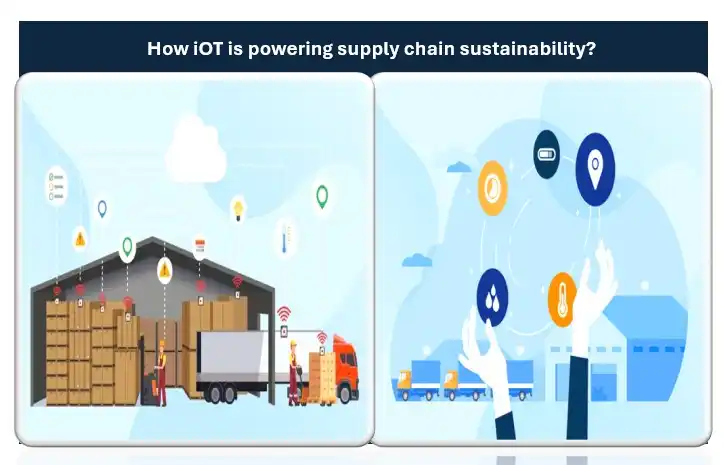
Today, sustainability has become an integral strategy within the supply chains of organizations, owing to mounting pressures to contribute positively to the environment, ensure sustainability, and adopt responsible business practices. The Internet of Things (IoT) plays an active role within this transformation. One of its abilities to contribute positively within supply chains includes its capacity to develop a greener supply chain and an efficient supply network.
Need for a clear understanding of IoT in the Context of the Supply chain:
Internet of Things: This is a network comprising physical devices such as sensors, RFID, GPS tracking devices, as well as smart meters, that are connected to the internet and can retrieve data. In supply chain management, the IoT is embedded through various stages such as sourcing, production, Fulfillment, warehousing, and distribution. This allows for constant monitoring so that a company is able to track their environmental performance and make data-driven decisions to enhance their sustainability efforts.
Enhancing Visibility and Transparency
Lack of visibility is one of the most key challenges to sustainable supply chains. IoT allows for end-to-end transparency whereby goods, materials, and resources are in the cloud and tracked in real time. Sensors monitor location, temperature, humidity, and handling conditions of products as they flow through the supply chain.
This helps companies by bringing transparency in the following:
- Identify waste and inefficiencies
- Comply with the environmental and ethical standards
- Verify deforestation-free sourcing and fair labor practices
With correct information, organizations can also share sustainability metrics with stakeholders, regulators, and customers to ensure trust and accountability.
Reduce Energy Consumption and Emission
IoT significantly helps in energy efficiency across supply chain operations. Smart sensors and meters monitor energy usage in factories, warehouses, and transportation fleets. From analyzing this data, companies can find out from where excessive energy consumption is coming and optimize operations.
For example:
- Smart lighting and HVAC systems make automatic adjustments according to occupancy.
- Equipment performance data informs energy-efficient machine use.
- Route optimization systems reduce fuel consumption and carbon dioxide emissions.
For logistics, IoT-based fleet management systems enable increasing efficiency by managing vehicle idle time, driving behavior, and delivery routing to decrease GHG emissions.
Effective Resource Use and Reduction of Waste
Reducing waste is a very essential component of sustainability, and this is made possible using IoT. The ability to monitor in real-time enables businesses to handle inventories more effectively, thereby reducing overproduction and spoilage.
The temperature and humidity sensors for perishables optimize storage and transport conditions. Trigger alerts are set for thresholds that are breached to avoid perishables’ deterioration and food waste. The use of resources like water, material, and chemicals in factories is optimized by the use of IoT data.
Predictive maintenance using IoT technology not only helps to minimize waste through the detection of potential failures before they even happen. This prolongs the life span of the asset and prevents material loss.
Supporting Sustainable Procurement and Ethical Sourcing
The IoT assists in ensuring that raw materials are produced sustainably. Using RFID tags and blockchain-based IoT technology, organizations are able to track their raw materials to their point of origin. The traceability ensures that organizations abide by sustainability requirements, such as limiting deforestation, sustainable mining, and fair labor practices.
By being able to verify the supplier performance based on real-time data, organizations have the ability to:
- Use environmentally responsible suppliers
- Monitoring Compliance with Sustainability Certifications
- Mitigate risks related to unethical sourcing practices.
Facilitating Circular Economy Practices
A circular economy relies on the principles of reuse, recycle, and prolong the use cycle of the product. IoT helps in achieving the objective of the circular economy as it assists in the tracking of the product even after the point of sale. Electronic devices incorporated inside the product can track the use and performance of the product during the entire lifecycle of the product.
This data adds to:
- Efficient product returns and reverse logistics
- Opportunities in Refurbishment and Reman
- Improved recycling and material recovery practices
To illustrate, the data provided by IoT is used in the conservation process.
Improving Decision-Making Through Data Analytics
The IoT produces a tremendous amount of data, and when this data is integrated with analytics and AI, the results can be very insightful for sustainable decision-making. Organizations can analyze several scenarios, predict future requirements more precisely, and manage costs while considering sustainability.
Data-driven insights enable organizations to:
- Establish measurable and specific sustainability objectives
- Monitoring Progress for ESG (Environmental, Social, Governance) Outcomes
- Enterprise-wide improvement of supply chain performance
Such a proactive mindset changes the nature of sustainability from a compliance-oriented to a proactive approach.
Although IoT has a lot of sustainability advantages in store, there are still challenges that this emerging field is facing. Some of these challenges include cost of implementing IoT concepts, data security, incompatibility of devices, and the effect of IoT devices on the environment in terms of e-waste that is produced.
The future will see the integration of IoT with other emerging technologies like AI, digital twins, and blockchain. When the technology reaches its full development stage and costs reduce, the sustainability of IoT will no longer be the exception.
Conclusion
The Internet of Things is transforming the sustainability of supply chain management. The Internet of Things is increasing efficiency through real-time visibility, allowing companies to make ethical sourcing choices, reducing waste and increasing sustainability, and closing loops to enable circular economies. By adopting Internet of Things, companies are provided with an opportunity to make sustainable choices while increasing resilience while remaining environmentally responsible as sustainability is categorized as an obligation as well as an imperative.
