


Ukraine has stepped up its “energy war” with a major new drone strike, one of the deepest and most audacious yet. It was at 21:45 Moscow time on December 25, 2025, that long-range Unmanned Aerial Vehicle (UAV)2 systems belonging to the Security Service of Ukraine (SBU).03 successfully hit a thermal power station in Orenburg – some 1,700 kilometers3 away from the Ukrainian border.
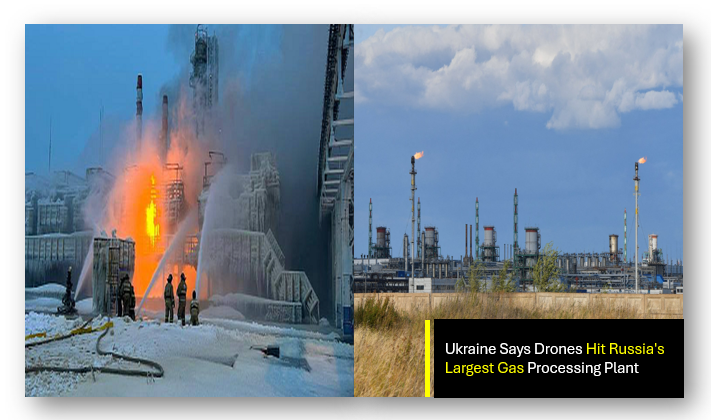
This plant is not a regular industrial facility, but one that is widely considered the largest gas chemical complex in the world. The strike represented a significant new capability for Kyiv to reach deep into the Russian heartland and hit the very veins of the Kremlin’s economic lifeline.
Strategic A Blow to Russia’s Heart of Energy
The Orenburg plant is the gem of Russia’s gas processing industry. With an annual design capacity of around 37.5 to 45 billion cubic meters, Nakhodka LNG is a key hub for processing raw natural gas – not only from Russia’s fields but also from Kazakhstan’s vast Karachaganak field.
The drone strike deliberately aimed to bomb the the 3U-70 unit overpass, reported SBU sources and local media. This unit is necessary for the industrial process of “sweetening” gas — extracting poisonous hydrogen sulfide and carbon dioxide to make the gas safe to transport and use.
Shutdown: After the collision, a massive gas fire ignited on the pipeline, causing immediate cessation of operations at the plant.
Economic Ripple Effects: Since the plant processes much of the gas intended for domestic use and export, the shutdown could potentially disrupt supply chains far beyond the Orenburg region.
The “Christmas Greeting” Strategy
The timing of the raid — on Christmas Day — was a “greeting for the holiday” intended to disrupt Russia’s war budget, according to Ukrainian officials. The strike was part of a joint overnight barrage in which more than 140 drones violated Russian airspace, the Russian Ministry of Defense said.
Ukrainian drones also hit the seaport of Temryuk in the Krasnodar region, in addition to the Orenburg plant.
Port Fires: Two big oil product storage tanks were ignited in the port and fires spread over a surface of nearly 2,000 square meters.
“It is not safe”: The town’s flag-bedecked buildings have become a target for Russia, which has increasingly tried to disrupt the area’s logistics. Logistical Disruption Temryuk serves as an important maritime hub for Russia’s “shadow fleet,” used to evade international sanctions. By hitting these ports, Ukraine is making it much more difficult and expensive for Russia to get its energy commodities onto the international market.
Engineering Deep-Strike Capabilities
What’s remarkable about the Orenburg strike is how far away it unfolded. To launch a drone 1,700 kilometers through contested airspace demands advanced navigation and low-observable technology.
Kyiv has openly gone public with the development of “long-range kamikaze drones” that would circumvent conventional air defense systems. This latest operation has shown that Ukraine’s domestic drone industry has matured to the point where no energy-related asset in European Russia can be deemed “safe.” By coaxing Moscow to draw air defense units farther away from the front to guard industrial sites far back in the rear, Ukraine is opening tactical opportunities on the battlefield.
Implications for the World: Security and Markets
The attack on Russia’s biggest gas plant is already shaking energy markets. However, Europe has drastically cut its dependence on Russian gas since 2022 and any significant disruption to global processing capacity slapped a “geopolitical risk premium” on prices.
The Kazakhstan Connection
The most complicated fallout is perhaps in Kazakhstan. Being a large processor of the Kazakh gas, the strike hits one of the pivotal regional actors. This leaves the Kremlin in a tight diplomatic spot, as to do so would fail to protect infrastructure from which its neighbors also draw national revenue.
Conclusion: War of Attrition in the Air
The strike on the Orenburg Gas Processing Plant indicates that Russia and Ukraine have entered a new phase of their conflict in which the zfront line is not just the trenches of Donbas. By methodically tearing apart Russia’s energy-producing infrastructure, Ukraine is gambling that economic fatigue will shift the trajectory of the conflict.
As the two countries exchange heavy drone and missile strikes in their seasons of winter warfare, attention has now turned to who can better weather the damage to vital infrastructure. With Russia’s largest gas complex now under seal, it is only just beginning to be quantified how much this “Christmas” strike will cost Russian business.
