


The city, a Russian and European crossroad on the Black Sea that has been battered by war throughout its history, is serving as ground zero for a stark escalation in the Russia-Ukraine conflict just off-railed by two decades. In the past 72 hours, an unrelenting barrage of ballistic missiles and “kamikaze” drones has decimated the region’s key infrastructure, plunging the city into a state of emergency.
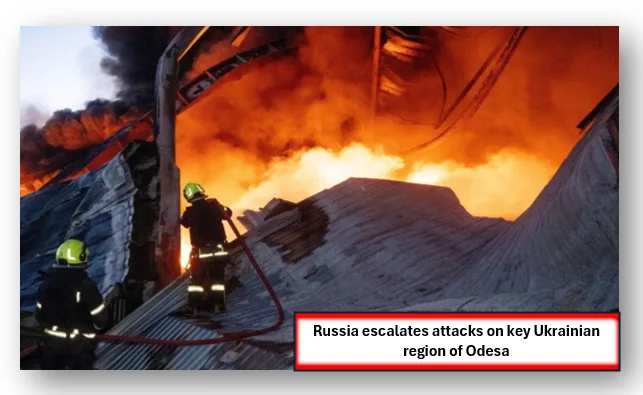
What was a thriving seafaring city is now awash with fire crews and rescue workers, as Moscow steps up its campaign to cut off Ukraine’s “economic windpipe” in the dead of winter.
The Latest Strikes’ Toll
The violence escalated over the weekend and into Monday, Dec. 22, 2025. A large ballistics missile attack on Pivdennyi Port, one of the country’s most crucial export gateways led to a devastating tragedy for the local community.
Casualties: At least eight people were killed and 27 injured when a missile hit a logistics area. Tragically, a passenger bus was at the epicentre of the blast, with many of those killed thought to have been inside the vehicle.
Infrastructure Damaged: The warehouses and the cargo areas were hit in the strikes sparking a massive fire that burnt some 30 containers of flour and vegetable oil bound for export to world markets.
Energy Crisis :Attacks on energy installations have left the region in darkness. As of December 23 the power is out for tens of thousands the residents. That is a new outage in the wake of a week’s worth of blackouts that was already pushing the city’s power grid to the breaking point.
read also:
Strategic Sabotage: Why Odesa?
Military analysts say the escalation in Odesa is one piece of a Russian calculus that is designed to accomplish three main objectives:
- Economic Strangulation: By methodically wiping out port facilities and grain storage, Russia seeks to cripple Ukraine’s export-oriented economy.
- Logistical isolation: Recently, the bridge of Mayaky on the Fencing River at the border with Moldova had come under attacks — important for transport and logistics.
- Psychological Pressure: Targeting heating and electricity substations is its response to the upcoming drop in temperature, to demoralize the civilian population. Residents have staged small protests in some Odesa neighborhoods, venting their frustration with the lack of running water and myriad blackouts.
The Ukrainian Response
In the aftermath of devastating strikes, President Volodymyr Zelensky has indicated a major rethinking of the country’s defensive strategy. He recently reportedly plans to sack the chief of the Southern Air Command, saying there is a need for “fast and timely” response to changes in Russian aerial tactics.
But despite the destruction, Ukraine’s Air Force cited a high rate of success, saying it had shot down 58 out of 86 drones launched in the most recent overnight wave. As emergency response teams work around the clock, using “Points of Invincibility” to deliver heat, charging stations and water to thousands of people who have been left exposed to severe cold.
A Diplomatic Crossroads
The intensification in Odesa comes at a sensitive time globally. Missiles are falling on the Black Sea coast, one report says, while “shadow talks” have been taking place in Florida involving U.S. envoy Steve Witkoff and representatives of several European powers.
But that is not the Front at all on the ground in Odesa, where I have been. ‘‘I read that they had productive negotiations,’’ says the resident of southern Ukraine, where talk of ‘‘productive negotiations’’ seem another world away from the daily sound of air raid sirens and a glow on the horizon as warehouses burn.
