


The Foreign Minister of New Zealand has made an open criticism of the trade agreement that has just been concluded with India, pronouncing it a bad deal that is not only insufficient in defending the economic and strategic concerns of New Zealand. The comments have provoked a political discussion in Wellington despite the fact that both governments publicly argue that the agreement is a step towards the bilateral relations.
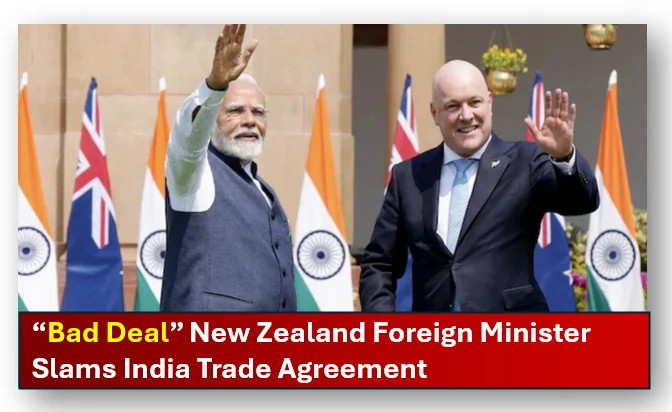
Critical Blow By New Zealand Government
In an interview with the local media, the New Zealand Foreign Minister Winston Peters stated that the agreement, as it exists now, presents few benefits to New Zealand exporters, but has considerable benefits to India. He cited that the main areas that had given immense significance to New Zealand, like agriculture, dairy, and meat products were granted much less access in the market than expected.
Peters claimed that the deal was not in proportion to what New Zealand had wanted them to offer in the form of concessions, but argued that what was offered back was disproportionate to the concessions made.
Trade Agreement to Strengthen Economic Relationships
The treaty, which had been signed earlier this year between India and New Zealand was estimated to be a boost towards enhanced trade relations between the two nations. Both sides had emphasized the issues of tariff cuts and enhanced access to certain commodities in both markets, as well as increased collaboration in services and technology.
India has repeatedly emphasized that the deal will be in line with its overall policy of increasing trade alliances in the Indo-Pacific region and safeguarding the sensitive sectors of its domestic industries.
Local Political Spillover in Wellington
The comments made by Peters have served to increase the political divide in New Zealand, with the leaders of the opposition accusing the government of poor negotiations. This, according to critics, could have been a missed chance by New Zealand to gain better guarantees of Indian performance in exporting its agricultural produce, which has been one of the oldest-standing Indian import bans.
Proponents of the deal, though, suggest that trade deals with India are necessarily complicated because of its sizeable domestic market and political sensibilities, and that unsteady progress is preferable to deadlock.
The Indian Standing is still reserved
Indian officials did not specifically react to what Peters said but have repeated that both the agreement was made in good faith and is a mutual compromise. New Delhi has always insisted that any trade agreement should be struck keeping a balance between globalization and the home economy, especially in agriculture and small industries.
According to trade analysts, India has traditionally been cautious about importing agricultural products, and this aspect has made it difficult to have an agreement with various developed economies.
What Happens Next
Although Peters did not go as far as to demand the rescission of the agreement, he indicated that in future revision mechanisms contained within the agreement, New Zealand may request revisions or enhanced protection. According to the diplomatic sources, both countries are prone to taking the dialogue further to avoid the disapproval that can percolate to the wider strategic collaboration.
Nevertheless, bilateral talks between India and New Zealand are likely to continue, even amid the controversy, with officials in both countries emphasizing the need to engage on a long-term basis rather than responding in the short term.
