


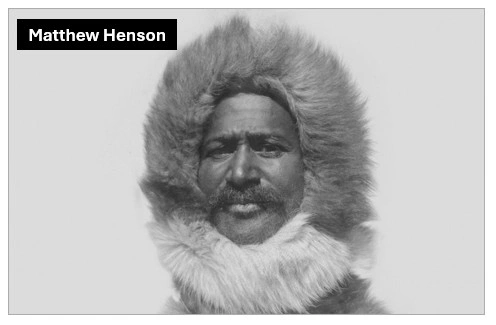
Matthew Henson was a master explorer, brilliant survivalist and a key figure in the early 20th-century race to the top of the world. He lived in a world of segregation and was the only one of Peary’s explorers to spend more than 20 years with him in the Arctic, when he was in the most lethal sub-zero conditions.
The amazing thing about Henson’s story is that he was probably the most able of the team on the 1909 expedition, physically the highest point on the earth first. However, his part in history was forgotten and his international achievements were quietly denied to his white counterpart, who came to international fame and great wealth.
Early Life
Matthew Henson was born on August 8, 1866, in Maryland, where he grew up free among free black sharecroppers, until racial violence and the death of his parents disrupted his childhood. He was orphaned at age of eight and left to fend for himself until he was 12 when he walked to Baltimore to find a better life.
There he enlisted in the merchant marine as a cabin boy on the ship Katie Hines. For the next six years, the ship’s captain, Captain Childs, tutored Henson in both reading and maths, as well as geography and master navigation. After Childs’ death in 1884, Henson moved back to land and became a clerk at a Washington, D.C., store.
Personal Challenges
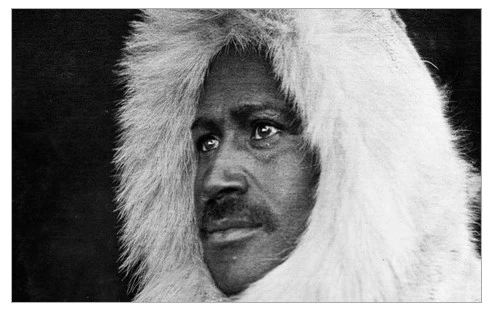
Henson’s life was a struggle with the harsh climate and prejudice of men. He endured temperatures of up to minus 50 degrees, blinding blizzards, ice floes, starvation and frostbite, while seeing his teammates lose their limbs to gangrene on countless attempts in the Arctic.
The social situation was as bad as at home. Jim Crow laws deprived him of many rights, although he was the backbone of all the expeditions. He was paid much less than any of his white counterparts, and was admitted to event venues through back service doors, including banquets that were held in his honor. As an adult, he was burdened with the cost of not being remembered and was struggling to make ends meet, yet his world-changing contributions were being ignored.
Career / Main Journey
Henson’s historic journey began in a chance meeting and culminated in an icy triumph.
Beginning of the Journey
In 1887 Robert Peary met Henson who was a shop clerk, and recruited him as an expedition member to Nicaragua. When attention turned to the North Pole, Henson was an indispensable member of Peary’s team because of his keen intelligence and naval training.
Major Breakthrough
Henson became the leader of the trail on more than seven brutal Arctic journeys from 1891 to 1906. Eventually frostbite took Peary’s eight toes, and he had to be pulled on a sled, but Henson learned the Inuit language, how to build igloos and dog-sled driving.
Rise to Fame (Delayed)
During their last charge, on April 6, 1909, Henson was incapacitated and Peary led the way. By his own estimates, Henson landed at the geographic North Pole by navigating through what was at the time still a blinding mist, and he was the first person to put his foot on the ground.
Must read:
- Nusrat Fateh Ali Khan king of Globalized Sufi music
- Dennis Ritchie Creator of the C programming language
Major Achievements
Although his awards came too late, Henson’s achievements changed the face of polar research.
- Reaching the North Pole (1909): Co-led the team that successfully made it to the North Pole despite the most dangerous terrain on Earth.
- Mastery of Arctic Survival: He personally designed the special sleds, trained the teams, and served as the crucial link between the American explorers and the native Inuit peoples whose survival skills were vital to the success of the expedition.
- Authoring History: He self-published a memoir in 1912, titled A Negro Explorer at the North Pole, a vital first-hand account, and a deeply humanized view of the historic expedition.
Personality & Character
Henson was extraordinarily physically courageous, utterly quiet and dignified under stress, and very resilient. They were impressed by him, and called him Aahglookook (“The Kind Conqueror”) because he was so kind and respected their culture, and he knew more about surviving on the ice than they ever had.
Final Years / Death
Decades later, his work was finally acknowledged. In 1937, Henson joined the prestigious Explorers Club and received a Congressional Silver Medal in 1944. He died on March 9, 1955 at age 88 at New York City, and was buried in a simple grave. In 1988, President Ronald Reagan decreed that his remains be moved to Arlington National Cemetery and he was buried with full military honors alongside Robert Peary.
Timeline
- 1866 — Born in Charles County, Maryland to free sharecropper parents.
- 1878 — Orphaned, signs for the Katie Hines merchant ship as a cabin boy.
- 1887 — Hires on as an assistant to Robert Peary in Washington, D.C. They will work together for 20 years under the pre-text of exploring the North pole
- 1891 — Participates in his first major Arctic expedition, this one to Greenland, acquiring Inuit survival techniques.
- 1909 — Foundes the route and arrives at the geographic North Pole on April 6.
- 1912 — He publishes his essential primary history A Negro Explorer at the North Pole.
- 1937 — He is elected a member of the Explorers Club after his death.
- 1955 – Dies in New York City at age 88.
- 1988 — Reinterred in Arlington National Cemetery with Peary and given full national honors.
