


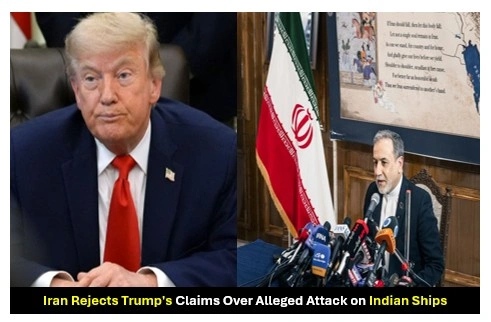
The standoff has reached a high diplomatic level on the international stage, putting delicate geopolitical balances and current peace efforts at risk. U.S. President Donald Trump has been stoking fears of Iran’s drone attacks on commercial merchant vessels with Indian crews near the critical Strait of Hormuz.
Tehran responded to the strong allegations made over the weekend with a quick and furious protest. The Iranian government strongly refuted the allegations as “baseless,” and blamed the United States military for the recent maritime fatal accidents that saw the deaths of several Indian sailors.
The Incitement: Trump’s Truth Social Proclamation
The diplomatic dust-up that now rages erupted when President Donald Trump launched a broadside against the Iranian regime in his social media platform, Truth Social. Trump denounced reports of a “maritime clash” against an Iranian “offensive” on commercial shipping routes as “unconfirmed” and expressed his anger in that regard.
Trump stated in all caps “Their totally rebuffed Drone attack last night against Indian Ships leaving the Hormuz Strait is TOTALLY UNACCEPTABLE. “They need to get their shit together.
Trump used the occasion to denounce Tehran for a leaked 14-point draft peace memorandum aimed at easing regional tensions, in addition to the immediate tactical accusations. Trump charged Iranian officials have been playing a “game” by releasing false and “massaged” parameters of the written deal to “mainstream media.” He called the Iranian negotiators “very dishonorable people to deal with,” and said that what they said in public and what was being written in the texts did not match.
Also read:
- PM Modi Says Farmers Welfare Remains a Top Priority for the Government
- Mamata Banerjee to join Congress after 28 years
Tehran Fires Back: “A Pathetic Diverting of Public Attention”
Iran’s response was instant, coordinated and uniquely pointed, going straight home via its New Delhi diplomatic mission. The Iranian Embassy in India issued a formal denial of any involvement in such drone strikes against merchant shipping, and had the finger pointed straight at Washington.
The embassy claimed the White House’s public allegations were “a well-crafted public relations ploy to hide its recent acknowledgements by the US military command of operations in the Gulf of Oman.
The Iranian Embassy in India said the allegation against Iran by the US president about an Indian ship in the Strait of Hormuz was “baseless. It’s a pathetic diversion to put the minds of the public off the brutal reality of the US attacking 3 Indian vessels in less than a week and killing 3 innocent Indian sailors.
India Caught in the Crossfire: Escalating Maritime Realities
The war of words comes in the wake of a series of troubling maritime incidents off the coast of Oman, which has been directly affecting the Indian citizens of the merchant marine fleet. In the last week, three separate commercial cargo ships, run by mainly Indian crew, have been trapped in the crossfire of regional military action.
The Marivec: Oil tanker disabled during an operational sweep by US Central Command (CENTCOM) and flagged by Palau with 24 Indian nationals on board. All crew members were able to be safely evacuated.
The Settebello: Another Palau-flagged commercial ship, the Settebello, was also struck with catastrophic damage by a military attack. As a result of the incident, three Indian seafarers lost their life.
The Jalveer: It was a merchant ship from Guinea Bissau, with 20 crew members onboard from India, which was fired upon in the disputed area near Shinas Port.
| Affected Vessel | Registration Flag | Indian Crew Count | Incident Outcome |
|---|---|---|---|
| Marivex | Palau | 24 | Disabled; all crew safely rescued |
| Settebello | Palau | 24 | Damaged; 3 Indian seafarers killed |
| Jalveer | Guinea-Bissau | 20 | Struck near Oman coast; investigation ongoing |
The Indian Ministry of External Affairs (MEA) did not stand down when the government started receiving reports of increasing casualties and the threats to the lives of its citizens. New Delhi has invited the US Chargé d’Affaires, Jason Meeks, to the South Block to strongly protest against the safety of commercial shipping lanes. Since then India’s Directorate General of Shipping has issued an urgent maritime security advisory to almost 18,000 Indian seafarers working all over the Gulf of Oman and the Red Sea corridor.
The Broader Context: A Peace Deal in Jeopardy?
The talk of bombs and bullets is particularly ill-timed for international diplomacy. Mediators, including senior figures from Pakistan and Oman, had just hinted at a 60-day truce proposal, designed to tear down parts of Iran’s nuclear program in return for $24 billion in frozen assets being unfrozen, as negotiations neared a conclusion.
However, regional experts are concerned that this latest conflict might stall the advances that have been made over the past few months as US Vice President J.D. Vance reiterated that no economic benefits or frozen funds will be given to Iran until the clear and verifiable denuclearization steps are met in full. As both sides level charges against one another for the loss of life at sea and for drone attacks, the prospects of a broader peace deal in West Asia seem to be slipping away.
