


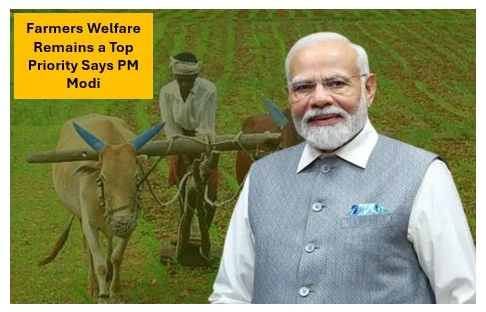
In a significant speech on strengthening the rural economy, Prime Minister Narendra Modi reiterated the welfare, economic security and technological empowerment of the nation’s agriculture sector is at the top of his administration’s agenda. The Prime Minister explained a multi-pronged strategy to shift the work of small farmers into highly profitable and resilient businesses in front of a large event of agricultural scientists, rural delegates and progressive cultivators.
For the Prime Minister, a self-reliant India or Aatmanirbhar Bharat cannot be possible without a structurally robust and prosperous agricultural fundamental structure. The government’s policy framework is geared towards a multi-pronged approach to improving the rural value chain, as opposed to providing short-term cosmetic solutions that do not tackle systemic problems. It involves predictable direct income support, encouraging the local adoption of climate-smart seeds and increasing the number of micro-irrigation schemes, and launching a more aggressive programme of local storage networks.
Direct Financial Empowerment: The Backbone of Trust
The institutional safety net is provided in the framework of the government’s grassroots approach through the PM-KISAN (Pradhan Mantri Kisan Samman Nidhi) scheme. Describing the program as a game-changer, PM Modi said that the days of leaky bureaucratic pipelines and middle-men have been made history. The administration uses the country’s well-established Digital Public Infrastructure (DPI) to make financial aid available immediately to the bank accounts of farmers who are active on the system, with no money lost in local administrative corruption.
This regular availability of cash flow provides the small and marginal families with the much-required financial space for purchasing improved inputs before the sowing season. This liquidity provided by the state can allow growers to make their seasonal inputs without being trapped by predatory local money-lenders for basic inputs of seeds and nutrients.
Read more: PM Modi Says India Is Leading the Green Energy Transition
Driving Scientific Integration and Smart Farming
The Prime Minister also stressed that the future of Indian agriculture hinges on the blending of ancient traditional knowledge with state-of-the-art scientific advancements. He called on the younger generation of agricultural scientists to make an effort to go out of the urban laboratories and work in the farms to support the farmers to face the unpredictable climate changes.
One of the key areas of this modernization process is the widespread use of agricultural drones and specific digital tools. Enhanced precision spraying technologies, such as the use of nano-urea, and crop health mapping using drone technology, are now available to smallholder communities through state-backed custom hiring centres. This high-tech method not only lowers water use but also saves labour hours, prevents the use of chemical pesticides and contributes to reducing the baseline production cost, and reduces the labour time involved.
Read more: PM Modi becomes India’s longest serving elected PM breaking Nehru’s record
Breaking Free from Local Cartels Through FPOs
The single most problem for India’s small farmers has been their extremely weak bargaining position historically. Small growers had less economic leverage to negotiate fair prices with the huge wholesale buyers, or to get access to big processing equipment as individual plots were less than 2 hectares.
PM Modi stressed on the need for a fundamental shift in the market imbalance and highlighted the establishment of Farmer Producer Organizations (FPOs) at an accelerated pace across the country. Under the guise of the law, smallholders are turned into strong corporate entities by coordinating their land, produce and resources.
These co-operative blocks are intended to enable the farmers to get the best of quality fertilizers and machinery at wholesale price and to enter into contract with the retailer chains without the intermediation of the middlemen. This structural change helps to place a much greater portion of the consumer’s final dollar into the hands of the hardworking rural families that did the work.
Building a Resilient Decentralized Future
In his concluding remarks, the Prime Minister once again reiterated that it is not enough to have infrastructure for agriculture in the fields; solid infrastructure of the industrial scale must be built right inside the villages of India in order to promote agriculture welfare. The current implementation of the Agriculture Infrastructure Fund (MBIE) is directly targeted at building decentralized cold storage, sorting and modern warehouses near rural centers, and is being implemented with a multi-billion dollar budget.
The government is creating long-term structural stability to rural prosperity by providing farmers with a place to store their perishable crops without having to sell them at prices they cannot afford, or in a time when there is an excess of them in the local market. PM Modi concluded with a strong statement that the government’s policies, allocation and technologies emerging from New Delhi will always focus on the growth, security and competitiveness of the Indian farmer at the global level.
