


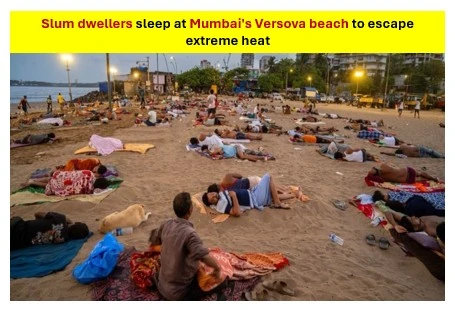
A strange incident has occurred at the Versova Beach in Mumbai where hundreds of people, especially families with children, have spent their nights on the beach because they cannot deal with the intense heat and constant power outages in the nearby areas. Videos on social media have displayed large groups of people sleeping under the stars, turning large portions of the beach into makeshift night-time shelters.
Due to the high heat and humidity combined with the lack of ventilation in most of the homes, residents have found their homes to be horrible during the evening hours, and most who are sleeping on the beach come from overcrowded slum clusters and from other low-income areas where the tin roof houses retain heat for long periods of time after sunset.
Heatwave Conditions Expose Urban Vulnerabilities
People who have been affected by this also feel like the recent extreme heat has just added to the difficulties with what is going on in their community. While Mumbai has a humid climate, the majority of the people who live here say the heat has been extreme in the past couple of weeks.
Nighttime temperatures for residents residing in small houses with inadequate ventilation are horrible compared to outside temperatures; thus, many people will be seeking out open air locations such as beaches and fields to escape the heat. Additionally, because these residents cannot keep cool inside their homes, many have been forced to sleep outside on the street and in public spaces.
Urban planners and climatologists have warned for many years that because they tend to have poor housing, cannot afford cooling devices, and urban infrastructure does not support a good living environment, low-income neighbourhoods are the most at-risk for extreme heat events.
Also read: Jammu & Kashmir Wraps Up 4th Mega Lavender Festival
Power Outages Add to Residents’ Misery
Electrical outages throughout multiple locations in Mumbai have made it that much harder for residents to find relief this summer. Neighbourhood residents have repeatedly complained of power outages, voltage fluctuations, and other forms of electrical outages both during the day and at night. In neighbourhoods lacking fans or air conditioning, very few people will be able to find a cool place to sleep this summer.
Also read: Neurologists say brain tumor signs that often get unnoticed
Hundreds Spend Nights on the Beach Seeking Relief
Problems with electricity distribution have been blamed on technical faults, old equipment and rising consumption due to the increased use of air conditioning as a result of the hot weather. While local power interruptions have become a point of growing frustration for residents, the authorities state that there is no overall shortage of power supply to the city.
Many of India’s electricity users are using more electricity than ever due to the increase in temperature across the country, with peak demand recently reaching 270GW as households and businesses turned to cooling devices to cool down from the heat. Despite the overall supply of power being more than enough in many areas, some parts of India have still reported local power interruptions.
Also read: Uttarakhand’s Valley of Flowers Reopens for Tourists
Viral Videos Spark Debate on Housing and Inequality
Viral videos of people sleeping on Versova Beach have sparked debate about housing affordability, migration, poverty and access to public spaces in India’s commercial hub. Many commentators have expressed shock at the sight and consider it further evidence of growing inequality in urban areas.
Others have used the videos to point to the massive lack of affordable housing available to low income workers in overcrowded housing with inadequate infrastructure. The footage is being used to once again question whether Mumbai’s development has kept up with the growth of its population.
Many public policy analysts believe that the challenges posed by climate change are much broader than just weather patterns. Seeing families living on the street speaks to larger challenges related to lack of affordable housing, access to basic services, and climate-resiliency in one of the world’s most densely populated metropolitan areas.
Potential Future Impacts from Climate Change
Scenes like those from Versova beach are increasingly being deemed a harbinger of what city dwellers can expect from global warming. Researchers warn that heatwaves in much of South Asia are becoming both more severe and more frequent, thereby increasing the strain on our electrical grid and public infrastructure.
Lower income households have very limited options to adapt to rising temperatures. While many cannot afford an air conditioner, poorly designed housing increases the radiator effect. To protect vulnerable populations, officials agree that urban areas will need to invest in climate-resilient housing, improved electricity systems, public greenspaces and public cooling centres.
A Stark Reminder for Policymakers
As extreme weather torments Mumbai, the hundreds of humans sleeping on the beach in order to avoid heat and power outages make up a poignant symbol of the differential impacts of climate stress. Despite the benefit of the occasional sea breeze, the problems of housing/city infrastructure quality, and energy supply sustainability still go unresolved.
For many families, the move to spend the night on Versova Beach is not an option; it is a function of need. The many millions of vulnerable residents of the city are experiencing the greatest impacts of increasing temperatures and limited urban services.
