


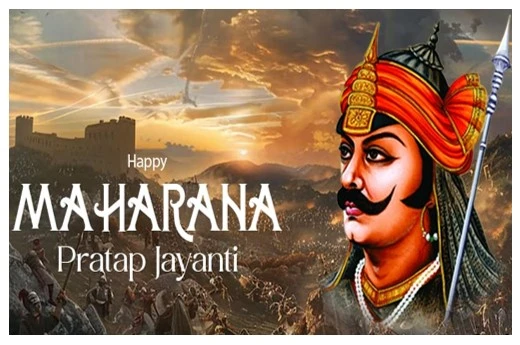
History tends to sanitize people, to make them into marble statues of their heroes. In textbooks devoid of emotion, we read about kings and warriors, tally up their victories and record their birth and death dates, until they seem more like an imaginary character than a flesh-and-blood person.
However, once in this rugged and sun-kissed landscape of Mewar in Rajasthan, it is strange how fresh Maharana Pratap’s memory remains. It is not a cold stone, it is in the soil, the local folklore, and the strong pride of the people.
The birth anniversary of Mewar’s greatest king is celebrated with utmost devotion throughout India on the day of Maharana Pratap Jayanti. The date will vary slightly each year as the Hindu year is lunar based. His birth anniversary was observed on 18th June, which falls on the Tithi (tithi number 3) of Jyeshtha month (Gregorian birth date of May 9, 1540) in the year 2026.
This day is not just a day of historical remembrance. It’s a celebration of a man who preferred an existence of extreme physical suffering, hunger, and banishment from his homeland over the easy comfort of total surrender.
Born to a Fractured Kingdom: The Making of a Rebel
Born at the beautiful cloud-capped Kumbhalgarh fort, Pratap Singh was the son of Maharana Udai Singh II and Rani Jaiwanta Bai. His youth was steeped in an independent culture from the very beginning. His mother, a woman of great spiritual strength, taught him all about righteousness and duty.
In 1572 Pratap became the ruler of Mewar and it was during his rule that the political situation of India was completely under the control of Mughal Emperor Akbar. Every wealthy princely state of Rajputana was falling prey to imperial power for wealth, comfort and high dignities at the court, and they were all giving up their sovereignty, one after another.
Mewar was alone in all this. Akbar sent six diplomatic missions to Mewar offering peace, security and great power to Pratap if he would merely bend the knee.
Pratap responded with an unconditional and historic ‘NO’. He knew that to be a kingdom bought by the price of subservient service, it was not a kingdom worth ruling.
Also read:
- YMA Day 2026 All You Need to Know About Mizoram’s Important Observance
- What Is the 5-Finger Breathing Technique? What Are Its Benefits?
- Jammu & Kashmir Wraps Up 4th Mega Lavender Festival
The Bread of Grass: Life in the Aravali Jungles
After Haldighati of, Pratap’s life was a saga of survival. He forfeited his fortress of Chittorgarh, Kumbhalgarh and others. He, his Queen and his Children turned nomads in the thick, inhospitable Aravali Hills.
During this time, all of the royal pompa was removed. The royal family had to live on the ground without any blankets or walls, and with the danger of the wild animals. Money was non-existent. There is a popular tragic story that the family were forced to eat bread cooked from the wild grass seeds known as ghas. One night while the king, Pratap was in the midst of deciding to hand his daughter over to the enemy, for the sake of his hungry children, a wild cat seized a slice of this grass bread from his daughter’s weeping hands.One night, while the king, Pratap, was considering surrendering his daughter to the enemy for the sake of his starving children, a wild cat stole a slice of this grass bread from the weeping hands of his daughter.
The Great Turnaround and Final Years
The savior of the movement was a rich trader and minister of Mewar named Bhamashah. Patriotic as he was, Bhamashah went to the forest and laid down his savings, which had been enough to finance an army of 25,000 soldiers for a full twelve years, at Pratap’s feet.
Now with renewed strength, Pratap unleashed a brilliant and relentless counter-offensive. He used guerrilla warfare and gradually recovered almost the entire Western Mewar, with Udaipur and Kumbhalgarh as his base, and set up a temporary capital at Chavand. In his last years he rebuilt the shattered agrarian economy of his state, and he was a patron of art and literature.
Legend has it that even Maharana Pratap’s bitter enemy Emperor Akbar cried at his death after he died at the age of 56 from a hunting accident on January 29, 1597. He cried because he saw that a time had passed—the time of the hard-and-fast opponent who was immune to any manipulation.
