


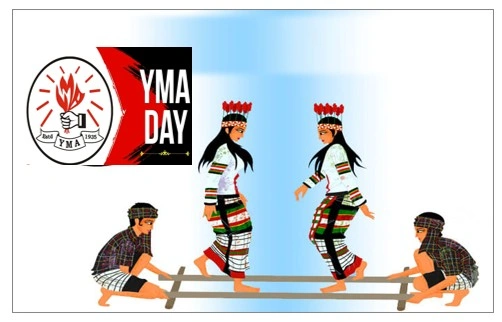
In Mizo, there is a word that cannot be easily translated into English. A word that embodies a way of life, a strong sense of morals and the very essence of a people: Tlawmngaihna. It is a virtue of being self-sacrificial, chivalrous, and giving a lot of one’s self to the good of the whole, giving up one’s own comfort for the sake of others.
This beautiful cultural feature is not only about a culture in textbooks of Mizoram; it is a reality that has been created by one organization.
The entire State of Mizoram suspends their normal operations and celebrates YMA Day (Young Mizo Association Day) every year on 15th June. A regional public holiday (RPH) is a holiday where schools, banks and offices are closed, but the day is far from being a quiet day spent sleeping in. Rather, the streets are alive with a unique vitality. Ten thousands of people roll their sleeves and get outside their homes and work in the community for hours, and do so voluntarily.
Rebuilding the Ancestral Shield: The Genesis of YMA
It takes the imagination of a reader to understand why YMA Day is so full of emotional resonance if one has to go back to the early 20th century. Mizo society was traditionally held together by a communal dormitory for young men known as the “Zawlbuk”. The Zawlbuk was the place where character was tested and where boys learned to be disciplined, to respond to emergencies, and to become protectors.
The system called *Zawlbuk* began to gradually be broken up by the tide of British colonial administration and the Welsh Christian Mission in the hills. This left a huge structural and cultural void. What would it take for the youth to learn accountability? Who was to protect the weak?
With Welsh missionaries and visionary local leaders, a new seed was planted in Aizawl on June 15, 1935. They formed the Young Lushai Association which was subsequently beautifully renamed Young Mizo Association in 1947 after Independence of India. It was clearly created as a non-political, non-religious, secular sanctuary for all Mizos to visit and replace the lost Zawlbuk.
read more: Radhika Ambani says Bhagvad Gita is her favorite book at IIMUN
The Three Anchors and the Ten Promises
The YMA strives to achieve three elegant and simple goals that inform the actions of its members on a day-to-day basis:
- Good use of leisure time.
- The all-round development of Mizo society.
- Respect for Christian and ethical living.
Above the age of 14 every who enters into the fold, makes ten sacred commitments. These include family righteousness, absolute truthfulness, politeness, cultural preservation, and a pro-active approach to the shadow of substance abuse and alcohol in the community.
This moral structure can be found in the YMA flag. The torch, a symbol of fire, is surrounded by three strong colours, white for sanctity and pure intentions, red for bright courage, and black for deep compassion for poor, marginalized people.
read more: World Blood Donor Day Raising Awareness About Safe Blood Donation
A Brotherhood That Stands by the Grave
The real strength of the YMA—and what makes it one of Mizo’s pillars of civil society—is when its branches are needed most: at life’s beginning and end.
The state doesn’t wait for the municipal workers or paid services when people die in the neighbourhood of a village or town. The local YMA branch springs into action. Its members bring their own work and visit the family’s house while someone is grieving to console them, cook their food and take care of their house for at least three nights and three days straight.
The Human Impact of YMA Day
On 15th June 2026, YMA Day comes alive as a stunning, tiring event of sweat and unity. Communities come together to clean up public areas, sweep away debris before inundation from the heavy monsoons, repair poorly constructed bamboo houses for impoverished widows, and bring truck loads of donations to local orphans homes.
YMA Day is a moving, heartening reminder about the possibilities of a society that chooses to carry no burden alone. It demonstrates that the true culture lies not in monuments, but in someone being willing to stand by another who is willing to stand by him.
