


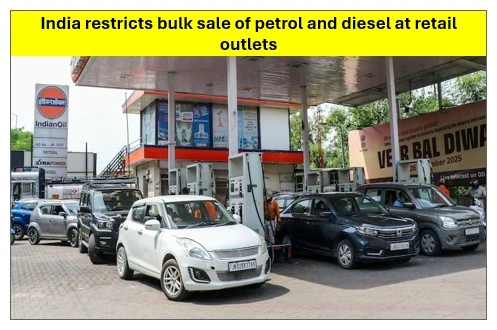
Temporary restrictions have been placed by the Union government on the sale of petroleum products, temporarily stopping the sale of gasoline and diesel to industrial, commercial, and institutional customers through regular gasoline stations. That is to remain in effect for 90 days unless otherwise stated.
Centre Imposes Temporary Curbs on Bulk Fuel Purchases
Under the new guidelines from the Ministry of Petroleum and Natural Gas, bulk fuel customers must now acquire their fuel needs via either their own consumer fuel pumps or bulk sale sites rather than through traditional retail outlets. The reason for this is to make sure that ordinary consumers have enough gasoline and diesel available to them, while also preventing distortion of the retail gasoline and diesel market.
Why has the government instituted this policy?
The government decided to make this change due to the very large increase in gasoline and diesel sales at traditional retail stations in various parts of the country. Authorities believed that the customers buying large amounts of gasoline and diesel from retail stations have done so because the retail price is less than the price of equivalent amounts of gasoline and diesel purchased through bulk deliveries.
A widening gap between the prices of retail and bulk fuel prices prompted large volume consumers (transport operators and industries) to shift their purchases from bulk to retail or public fuel stations resulting in increased demand for diesel at retail fuel pumps and shortages of diesel in specific areas thereby creating supply pressures for individual consumers.
Government officials believe that limiting bulk fuel sales at retail fuel stations may result in a more equitable distribution of fuel and will prevent the large-scale diversion of supplies.
also read: Assam’s Famous Tezpur Litchi Goes Global with First Export to Dubai
Diesel Fuel Sales Limited To 200 Litres Per Day
As part of the newly implemented framework, retail fuel station operators are not permitted to sell high-speed diesel to any single customer/vehicle on any single day in excess of 200 litres. Retail fuel purchased from retail fuel stations may not be used for resale.
The limitation of fuel sales was instituted so that there is no hoarding and fuel is available throughout the country. In addition, the Government has directed that the sale of diesel be conducted only from the fuel tank of a vehicle or from an approved container that complies with the appropriate safety standards.
also read: Is China driving Japan’s growing investment in India?
Global Supply Chain Disruption Impact
The restrictions on fuel supply come at a time when there is volatility in the global energy market and disruption to the petroleum supply chain. Continued geopolitical conflict in the Middle East has raised concerns about reliable access to crude oil supplies.
Government officials believe that these measures will help to guarantee a stable supply of petrol or diesel at gas stations throughout the nation. They state that the reason behind the restrictions is not to restrict cars owned by consumers from accessing fuel but to prevent consumers from panic buying fuel or hoarding fuel when the market is making drastic changes.
Retail Fuel Access for Consumers
Experts believe that private vehicle operators, two-wheeler operators and regular consumers who refuel their vehicles will not be affected by these restrictions. The target of these restrictions is to keep large-scale industrial, institutional and commercial buyers from purchasing too much fuel.
The government expects that implementing these new restrictions will help to ensure an adequate fuel supply for retail outlets. By controlling the flow of fuel into retail outlets, the government believes that it can reduce the amount of fuel that is diverted to bulk consumers, which puts pressure on retail outlets.
Increased Demand for Fuel is Affecting Oil Distribution Companies Financially
Due to the transfer of bulk consumers to retail gas stations, state owned oil distribution companies are now experiencing financial stress. The media has reported that government operated fuel distribution companies sell fuel at significantly lower than market prices to consumers. This has created a financial strain on the government operated fuel distribution companies.
As larger commercial customers continue to procure their fuel through retail outlets, major oil marketing companies have incurred losses while there has been significant increases in retail fuel consumption in some areas, due to a mismatch between the price of fuel for bulk purchase and retail price of gasoline/fuel. As such, the restrictions currently in place are designed to assist companies in managing supplies appropriately and to alleviate some of the segmentation caused by this.
Going Forward
The government has confirmed that these restrictions will be considered temporary and will continue to be evaluated. Although the order is to remain in effect for a period of up to 90 days, the government has retained the right to either repeal or continue the restrictions, based upon market conditions and projection of fuel supply.
At present, this policy is intended to help maintain retail fuel supply availability, control excessive demand from bulk purchasers and create stability in India’s fuel distribution system amidst instability of the global energy industry.
