


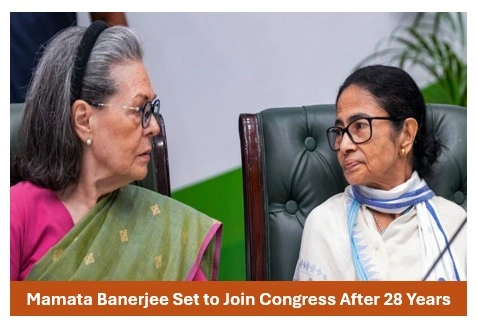
Mamata Banerjee, Chief Minister of West Bengal, has apparently made plans to rejoin the Indian National Congress. She has been an independent politician for nearly three decades. This development could be a big political change for not only West Bengal but for national politics, as it marks an end to her long-time independent political career since she started the All India Trinamool Congress (AITC) in 1998.
Political analysts suggest this will cause major changes in both national and regional political environments and will definitely influence the outcome of upcoming elections.
In the late 1980s and early 1990s, Mamata Banerjee became an influential leader of both the INC and the West Bengal Congress before leaving to form her party, AITC, in 1998. During that period, she began to publicly criticise the way the West Bengal Congress was structured and managed and used her newly formed independent political party to build on her reputation and establish one of West Bengal’s most successful political parties by defeating and ending the 34-year rule of the Left Front in West Bengal.
Therefore, her reported intentions of returning to the Congress Party, is a complete closing of a significant chapter in her career, and a reuniting of Congress with one of its brightest stars.
Reasons Behind the Move
Sources with knowledge of developments are suggesting that factors in the national political environment have ultimately influenced this decision. There has been a growing interest among opposition parties in exploring ways to strengthen their collaborative efforts to unseat the BJP in future elections.
Political analysts suggest that a merger or alliance involving Congress and Mamata Banerjee would enable opposition parties to better coordinate their efforts, thereby lessening vote fragmentation and creating a larger antigovernment coalition.
Read also: PM Modi becomes India’s longest serving elected PM
A Major Shift in Indian Politics
Another area of consideration pertains to regional political dynamics. Both national and regional parties appear to be increasing their efforts to form stronger coalitions; accordingly, leaders may also consider organisational consolidation as a means of increasing their electoral effectiveness.
While there has yet to be an official announcement regarding the specific terms of this potential merger, many within the political community are awaiting developments with anticipation.
Read also: PM Modi Says India Is Leading the Green Energy Transition
The Impact of this move on Politics in West Bengal
The greatest single impact of this merger would likely be felt in West Bengal, where TMC has been in power for more than 10 years. If Banerjee officially joins the Congress, the future of TMC’s organisational structure and leadership is uncertain. Individuals who have been building TMC for many years would likely want clarity regarding their roles in any restructured organisation.
This new event will alter the political balance of power in the State between Opposition political parties. The Congress party could benefit significantly from Mamata Banerjee’s re-entry into West Bengal due to her large base of support. However, opposition groups will also attempt to exploit the uncertainty of transition.
Read also: West Bengal CM Suvendu Adhikari Launches Annapurna Yojana
Political Responses going on
Political leaders and analysts from across the political spectrum started to have serious conversations about this development.
For Mamata Banerjee’s supporters, this move signifies a strategic effort to unify the opposition and coordinate the opposition together on a variety of national level issues. Most feel that broader cooperation between the parties which are currently a part of the opposition is very necessary at this time.
Leaders from the Congress party have welcomed most reports of this development, as it provides them opportunity to enhance their presence in Eastern India, as well as expand their political reach.
On the other hand, there are some critics who question whether the divisions associated with both previous ideological differences and past political rivalries between the parties could be resolved easily. Some analysts believe that Mamata Banerjee and leaders from the Congress party have had both cooperative and competitive relationships throughout the years.
National Implications
The decision has far-reaching implications that could affect how other states develop politically too. If Mamata Banerjee and the Congress party join forces, it might lead other regional parties to reevaluate their own alliances and approaches to governance.
Experts feel these developments could help create a unified framework of opposition. This type of adjustment also has the potential to change how politics are done at the parliamentary level, form coalitions with like-minded parties, and create future electoral strategies through joint campaigns.
It will serve as a visual representation of how political alliances change over time based on environmental changes and election results.
Moving Forward
While speculation is being tossed around, all eyes will be on the respective official announcements made by Mamata Banerjee and the Congress leadership. The upcoming days should shed some light on what this arrangement is going to look like, as well as give clarification as to what type of political aims they have.
Should this be accurate, it would make Mamata Banerjee’s shift back to Congress after nearly three decades a turning point in Indian politics and would ultimately have an impact on how all opposition parties operate and how they interface with each other as they prepare for elections for a prolonged period of time throughout the rest of the country.
