


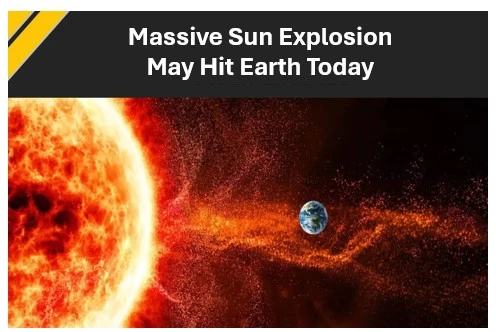
Scientists and space weather organizations have been keeping a close watch on today’s expected impact by a huge solar explosion from the Sun. Referred to as a Coronal Mass Ejection (CME), this large volume of plasma was released after a series of significant solar flares were released from a sunspot region classified as AR 4455. This event is predicted to generate geomagnetic disturbances, affect radio communications, and create amazing auroras across much of the world.
What was the Activity on the Sun?
The activity over the past week from the Sun has been huge. Multiple strong solar flares have erupted from the sunspot region AR 4455, including some M-class and X-class (the most powerful category of solar eruption) flares. On the 3rd of June, an X1-class flare exploded from the Sun releasing a tremendous amount of energy and throwing charged particles, at extremely high speeds, into space toward the Earth.
Scientists noticed that multiple CMEs were launched from the Sun very quickly, and that some of the solar plasma clouds merged as they traversed through space creating what researchers refer to as a “cannibal CME”. This larger CME may produce an even stronger solar storm because one CME overtook another CME during their journey through space.
read more: 27 potential planets discovered with two suns
NASA and NOAA Issue Geomagnetic Storm Alert
Space weather experts, such as NASA and NOAA, have placed a geomagnetic storm of G3 (or “Severe”) on the Geomagnetic Storm Scale. G3 storms are considered to be strong enough to produce some noticeable effects on technology.
This geomagnetic storm is expected to be caused by a Coronal Mass Ejection (CME) impacting Earth today; how strong that impact will be depends on the orientation and strength of the magnetic field of the material responsible for the CME.
read more: Super-Earth discovered Day-time temperature is said to be 725°C
Scientists Monitor Powerful Solar Storm
There will be no immediate threat to human safety on Earth, but the impacts of this geomagnetic storm will be felt when technology fails due to this type of storm.
Some examples of how technology can be affected during periods of strong geomagnetic activity include:
- High Frequency (HF) radio communications and other radio services experiencing disruption
- Global Positioning System (GPS) and other navigation services experiencing disruption
- Satellite operations may experience disruption
- Infrastructure affecting the power grid will experience disruption
- Aviation communications, particularly on flights traveling over polar regions, may experience disruption
On several occasions, previous flares from this same sunspot region have created widespread radio frequency blackouts across large parts of Europe, Africa, Asia and Australia. As a result, scientists will closely monitor the arrival of the CME expected later today.
read more: Gold factory discovered deep under the Pacific Ocean
Witness Auroras Farther than Normal
One highlight of a geomagnetic storm is the potential to see auroras, otherwise know as the Northern and Southern Lights. Very strong geomagnetic storms can create auroras much closer to the equator than normal.
Powerful Solar Eruption Heads Towards Earth
Skywatchers in various parts of Europe, North America, Australia, and northern parts of India have been informed that they might have a unique and possibly colorful viewing opportunity due to promising weather patterns that could lead to enhanced auroras.
Astronomers recommend using dark locations away from city lights for best viewing conditions. The amount of intensity and visibility of the auroras will to large extent, depend on how strong the storm is once it reaches Earth.
No Reason to be Alarmed
A number of news media organisations are carrying articles describing a “huge explosion of the Sun” and thus far, scientists have reported that these events are simply occurring during the natural cycle of solar activity. The Earth’s atmosphere and magnetic field protect persons on the surface of the Earth from the potentially damaging effects of the energy from the Sun.
Satellites, astronauts, and technological infrastructure may all potentially be impacted by this event as there is potential for this event to be quite strong; however, it is expected that this event will not surpass the level of the Carrington Event, the strongest solar storm ever documented, that occurred on 1859.
Scientists Continue Monitoring the Situation
As researchers all over the globe track the geomagnetic and other activities from the incoming solar storm in real-time, this event stands as a stark reminder of how closely connected modern day technology is to space weather and how active and how quickly our nearest star can change.
Today’s Solar Storm is anticipated to have both minor disruptions and beautiful auroras, making it one of the tops anticipated watched space weather events for 2026.
