


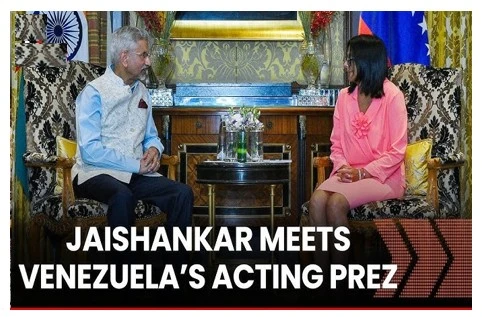
Global diplomacy, as it changes, does not occur in isolation. Typically they are motivated by the hard realities of economic need and resource survival. That was very much the case when India formally welcomed Acting President of Venezuela, Mr. Delcy Rodríguez, in New Delhi, four days ago, in high-profile fashion. Rodríguez held a discussion with External Affairs Minister S. Jaishankar before engaging in extensive bilateral talks with Prime Minister Narendra Modi at the Hyderabad House, and commenced a significant five-day working visit.
The visit has been promoted as an opportunity to strengthen bilateral partnerships and explore various sectors but it’s a much more serious underlying story. New Delhi is keenly changing its energy game plan, as it is grappling with huge supply insecurity from the traditional corridors of West Asian countries. In parallel, Caracas is going through an unprecedented political process at home, with India emerging as an important economic pillar.
A Very Unusual Transition of Power
To appreciate the gravity of the conversations that are happening at Hyderabad House one must go back to the dramatic political upheaval that re-shaped Venezuela earlier this year. Former socialist President Nicolás Maduro was arrested by the U.S. military in a remarkable military maneuver last January. Delcy Rodríguez, the country’s Vice President at the time, took over as Acting President in the tumultuous period following the change of government.
Her appointment to the top has been received with mixed feelings around the world. As Venezuela is under enormous pressure from the west, and countries such as Russia openly label the US intervention as illegitimate, India has taken a decidedly pragmatic middle course. The move is an effort by New Delhi to assert that continuity of government between the two countries is its prime concern, not the Western Hemisphere’s complicated geopolitical conflicts, justifying its acceptance of Rodríguez under her title as “Acting President”.
This does not seem to be the first encounter between the political leadership of Delhi and Rodríguez. This visit is her sixth official trip to India since 2015 when she visited the country as the Foreign Minister and Vice President. This extensive experience serves as a solid base for future negotiations, when Venezuela urgently requires foreign partners who will guarantee its economic stability and confirm its current transition process.
also read:
- US Attacks Iranian Military Targets
- Celina Jaitly Receives Legal Notice from Husband Peter Haag
- Japan stops importing mangoes after 20 years
The Catalyst: A West Asian Energy Crisis
The bilateral talk ranges from general drugs to sharing technology, but the obvious catalyst for this new diplomatic flurry is oil. The Indian economy is highly vulnerable to fluctuations in international crude oil supplies as the country is the third largest importer and consumer of crude oil in the world. In recent times, that sensitivity escalated to a full-blown logistical nightmare.
Escalating military tensions between the U.S., Israel and Iran have effectively made the Strait of Hormuz completely closed. It is one of the most vital shipping routes in the world, and was once responsible for more than 40% of all crude oil imported into India. Tanker traffic through the strait was almost completely stopped and Indian refiners were left with no choice but to seek other sources of oil, and fast if they didn’t want to run short of supplies at home.
Venezuela’s proven crude reserves, about 17% of the world’s reserves, was the perfect substitute. Indian refiners, including the biggest buyer Reliance Industries, quickly switched buying patterns. In May, India’s crude imports from Venezuela jumped to a dazzling 427,000 bpd. The sudden rise led to India becoming the world’s second-largest importer of Venezuelan crude oil after the U.S.
But navigating the politics of the current day is tricky when it comes to Venezuelan oil. After making an agreement, Washington has a tight grip over Venezuela’s energy revenues by controlling bank accounts through the Treasury. India’s successful expansion of these purchases demonstrates one of its sophisticated diplomatic gambits: how it can keep friendly relations with Washington while obtaining the heavy crude it requires to keep its refineries going.
Expanding the scope to go beyond crude oil
Both delegations are keenly aware that a resilient international relationship cannot be based on a single commodity, although oil is the obvious priority. During a fairly lengthy discussion, both sides discussed the wider range of India-Venezuela relations and found several areas where both countries have needs that correspond exactly with the other.
The pharmaceutical and health care industry is the most prominent of these. India has a huge capability of producing generic drugs, which is a tremendous asset for Venezuela. The South American country’s medical system is extremely stressed from the strict economic sanctions and internal political instability that have engulfed the country in recent years. Access to affordable and quality Indian medicines and medical equipment offer a welcome social cushion to the Venezuelan people in a challenging transition.
The high-level delegation with Rodríguez indicates a desire for a much more extensive economic relationship. The inclusion of the transportation minister is especially significant, as both parties seek tangible steps towards enhancing shipping logistics and lowering freight prices, a natural byproduct of trans-oceanic trade between South Asia and Latin America.
