


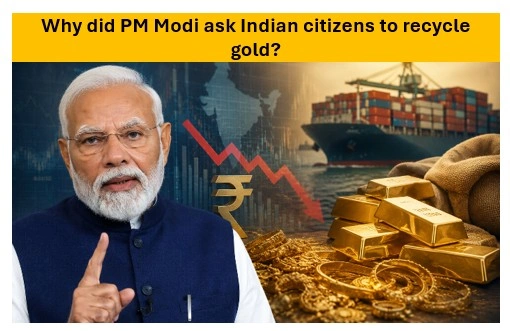
The Prime Minister of India, Narendra Modi is reaching out to the Indian citizens encouraging them not to purchase new gold and to recycle existing gold. He suggests that due to the current economic situation, it would be better if we start recycling our gold than buying new gold. There is a need for recycling gold given the difficulties with reciprocity and the pressures placed on India’s foreign currency reserves because of global energy prices and unrest in the Middle East.
India is one of the world’s largest gold consumers and importers; actual production within India is limited, therefore, nearly all of India’s total demand (i.e., 95% of all demand) for gold is imported by way of international currency, primarily U.S. Dollars.
In May 2026, Prime Minister Modi asked citizens to refrain from purchasing gold for non-essential reasons for one year regarding the conservation of foreign currency and other international economic uncertainty and that there has been an increase in the price of oil. In addition, the plans to move goods internationally have been severely disrupted due to the civil unrest in the Middle East.
The increase in the importation of gold due to the Indian importation of gold directly increases India’s importation prices and simultaneously causes additional pressure placed upon India’s foreign currency reserves. The increase in the importation prices will also cause a negative impact upon the value of the Indian Rupee.
India Already Has Huge Gold Stocks
One of the primary reasons why there has been an increased push for gold recycling is because of the vast amounts of gold that are already in the possession of this nation (India).
Recent estimates state that Indian households and temples combined currently hold anywhere from 30,000 to 35,000 tonnes of gold, most of which are locked away in safes and safety deposit boxes. The Government believes that if a small percentage of this inactive gold was recycled, the country could satisfy current domestic demand for gold without relying on further gold imports.
Experts agree that even recycling 1% of the overall amount of gold that is held in India each year would reduce India’s gold imports by as much as 25%-30%, which would greatly relieve the current pressure on the country’s foreign exchange reserves.
read also: USTR Proposes 12.5% Additional Tariffs on India and 53 Other Nations
Why is Gold Recycling Important?
Gold recycling refers to the process of recovering old, broken, unused or outdated pieces of jewellery, refining that gold and producing high purity gold to be used for making new jewellery, bullion and industrial uses as well.
Gold can be recycled numerous amounts of times without degrading its quality, which makes it a candidate to be part of a circular economy (where material resources are regenerated and reused) business model.
The jewellery industry has stated that recycling offers the following advantages:
- Reduces the need for imported (new) gold.
- Conserves foreign exchange.
- Reduces the negative environmental costs associated with gold mining.
- Keeps economic activity local to India.
- Allows consumers to upgrade their old gold jewellery by reusing their current gold; and not needing to purchase entirely new gold.
read also: Japan stops importing mangoes after 20 years
Industry Supports Recycling Over Demand Reduction
This has led many jewellers to question whether or not it’s appropriate to ask consumers to completely stop purchasing gold as a way of showing the government’s concern regarding import trends.
Industry representatives have stated that the jewellery industry in India is responsible for employing millions of artisans, goldsmiths, manufacturers, and small businesses. If there was a significant drop in demand for jewellery within India, there would be immediate job losses across the entire jewellery supply chain. Instead, the jewellery industry has called upon its customers to support the domestic mobilisation and recycling of gold.
Jewellers point out that many families will often trade in their old or unwanted jewellery item when they purchase new designs. This is a natural way of reintroducing recycled gold into the marketplace, which lessens the need for importing any amount of new gold.
read also: Byju Raveendran the founder of Byjus jailed for 6 months
How Can Consumers Be Involved?
According to industry experts, recycling doesn’t equate to giving up family heirloom-type jewellery. Consumers have the option of trading in or selling damaged, outdated or unwanted jewellery through approved or certified jewellers.
Common examples would include:
- Broken chains
- Single earrings without pairs
- Old wedding jewellery not being worn anymore
- Broken bangles or necklaces
Gold that has been recycled is then evaluated, refined, and may either be applied towards the purchase of a new piece of jewellery or produced into new bullion.
Economic Benefits Beyond Gold
Government is appealing this way because of the serious need to reduce imports for non-essentials and foreign currency reserves while the economy goes through instability worldwide.
In addition to discouraging new gold purchases, PM Modi also asked citizens to cut down on their fuel consumption, take public transportation, bring back work from home process, and limit any non-essential travel outside the country. All these recommendations are designed to decrease the dollar going out of the Indian economy.
Economists say that reducing the amount of gold imported can help the rupee hold its value, decrease the trade deficit and ultimately make India more economically sound in times of global economic uncertainty.
Conclusion
PM Modi’s request to recycle gold is based solely upon an incentive to encourage recycling from an economic point-of-view; it has nothing to do with trying to slow down the purchase of gold. Policy-makers believe that mobilising what is thought to be one of the largest private gold reserves in the world will allow for harmony between the unlimited consumer demands (via new purchases) via the economic means of maintaining economic viability in the importation of gold. Thus, for both consumers and for maintaining economic stability and future currency reserves in India, gold recycling is viewed as a middle ground by allowing Indians to continue to buy and utilise gold and thereby assist with conserving foreign currency and stabilising their economy.
