


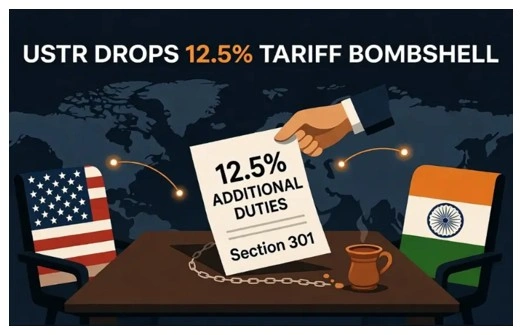
The United States Trade Representative (USTR) has offered to impose an additional 12.5% import tariff on India and 53 other countries. The broad trade action is in response to a Section 301 investigation finding that these key global economies have not implemented or effectively implemented domestic bans on goods made with forced labor.
The notice is the latest in escalating trade conflicts within the Trump administration. Labor law enforcement differences between the world and the U.S. are actually a liability to U.S. industries and to international trade, officials say.
The core allegations and U.S. rationale are presented.The core allegations and U.S. rationale presented.
USTR’s key focus in the investigation is on foreign government response from the global supply chain. Washington says that its global trading partners are also not keeping their end of the trade.For almost a century, the United States has prohibited imports from countries involving forced labor, but Washington says its trading partners around the world are not doing their part.
After a thorough study of the trade policies of 60 different economies, the USTR concluded that a large majority do not have the necessary legal structures and/or enforcement to exclude forced-labor goods. But this systematic weakness produces an imbalance in the world playing field, said U.S. Trade Representative Ambassador Jamieson Greer.
Greer made it clear that the failure of our key trading partners to take action on importation of goods produced by forced labor is unacceptable. This is a situation that requires American workers to compete against everyone else in the world on an uneven playing field and we will NOT tolerate it.
Tiered Tariff System and Affected Nations
The USTR has divided the 60 economies under investigation into two levels, depending on their current legislation:
- The 12.5% Tariff Group (54 Economies): India is part of the 12.5% Tariff Group (54 Economies), which also features other key trade giants like China, Japan, Brazil, Australia, South Korea, Saudi Arabia and the United Kingdom. The USTR claims these 54 nations have completely failed to both impose and effectively enforce a strict prohibition on the entry of forced-labor products.
- The 10% Tariff Group (6 Economies): Six economies — Canada, Ecuador, the European Union, Indonesia, Mexico and Pakistan — are proposing to have a lower additional levy of 10%. The USTR said that some of these trading partners already have some form of forced-labor import ban or have made them part of a reciprocal trade agreement (like the USMCA), but are not enforcing it with adequate rigor.
Also, the USTR has set out a plan to create a special “textile mechanism. This system would permit a limited amount of clothing and textiles to be imported from certain economies into the United States at a slightly lower rate of duty, thus dampening the initial impact on consumer economies that rely heavily on U.S. imports.
must read:
- Japan stops importing mangoes after 20 years
- Byju Raveendran the founder of Byjus jailed for 6 months
- India imposes restrictions on silver imports
India’s Rejection and the Diplomatic Fallout
New Delhi has strongly disputed the USTR’s claims, dismissing the forced labour allegations completely. Earlier, the Indian government formally presented the USTR with documentation which showed that the probe was not legally required to be initiated under Section 301 of the US Trade Act of 1974.
It’s important that the announcement is made at the right time. A high-level trade team from the U.S. is in New Delhi for a crucial three-day meeting to conclude the initial phase of a bilateral trade agreement (BTA) that has been for a long time in the works. Union Commerce Minister Piyush Goyal had earlier said that the major hurdles have been overcome and discussions were now at the “commas and full stops” stage.
Then comes the unexpected – a 12.5% extra tariff – and disrupts those talks. Sources in the Indian government say that the main concern for India is that they be able to find an advantageous tariff situation with respect to competing exporting countries. Officials in New Delhi have officially asked Washington to end the investigation and instead any residual labor issue to be settled within the cooperative spirit of the ongoing bilateral trade negotiations.
The next steps and public consultation process for this document are now underway.
It is important to emphasize that these further responsibilities have not yet come into effect. The USTR proposal is a starting point that is subject to public and industry review prior to final adoption as law.
The USTR has set a strict deadline for the pending litigation
- June 22: Interested parties, industry representatives and foreign governments can make a formal request to appear at the upcoming public hearings, and the breakdown of what they intend to say, is due by June 22.
- July 6: The date for submitting comprehensive written public comments about the proposed tariffs.
- July 7: the USTR will hold formal public hearings to consider the economic comments, possible supply chain effects, and typical diplomatic reactions before reaching a conclusion on enforcement of the tariffs.
