


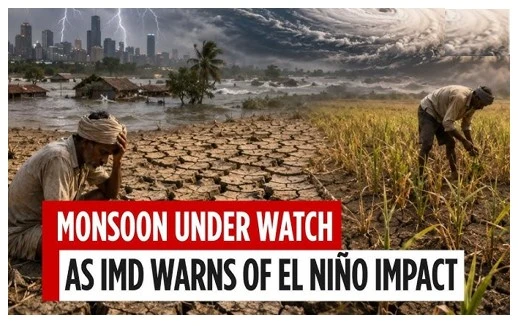
This year’s monsoon season in India could be less than normal. El Niño is forming in the Pacific and is responsible for below-average rainfall according to the India Meteorological Department (IMD). The agency has adjusted its monsoon forecast from 95% of the long period average (LPA) to 90% of the LPA, which is considered an indication of below normal rainfall for the 2026 monsoon season.
A strong El Niño could develop in the Pacific Ocean through the monsoon
El Niño is a weather event that is characterized by a rise in sea surface temperature over a large area of the central and eastern Pacific Oceans. A rise in temperature over such large areas creates different patterns of wind and precipitation all over the world. Also, meteorologists continue to observe a trend in which many of India’s drought years occurred during “strong” El Niño events.
Rainfall Distribution: IMD Warns of Below-Normal Monsoon
The IMD is forecasting below normal rainfall across many regions, including Central India, South Peninsular India, Northeast India and the core of the Indian monsoon, while parts of Northwest India are expected to receive near normal precipitation. According to climatologists, precipitation is expected to become less uniform, with longer periods of drought followed by short, intense storms. This degree of change would wreak more havoc than a complete lack of possibility of rain, as it would alter planting timelines and the existence of water.
also read: Indian tourists perform garba at Vietnam airport
Agriculture into Big Trouble
The monsoon is the key factor supporting the agrarian economy of India, with nearly fifty per cent of all agricultural land being dependent on rain as opposed to having irrigation available. If the monsoon weakens, production levels of key kharif grain crops such as rice, pulses, corn, and oilseeds are threatened. The majority of farmers in rainfed areas have the highest risk from the lack of precipitation, particularly if the dry spell continues through July and August. If crop yields drop, it can negatively impact rural income levels and subsequently, the entire economy.
also read: Amit Shah Orders Demolition of Illegal Structures
Inflation and Financial Risk
As the monsoon weather prediction will ultimately affect food prices, economist analysts have continued to be laser focused on the weather forecast. If the estimated crop quantities decrease due to precipitation problems, the cost of basic goods will go up consequently putting increasing strain on household budgets. There is a general consensus among analysts that if rainfall was to continue to be deficient that food inflation would rise dramatically. The other effect created by a weak monsoon is that rural consumption would generally decrease, therefore affecting other areas of the economy such as consumer goods, automotive, and retail. One recent study estimates that if production levels decrease greatly, inflation will dramatically increase.
also read: 14 days curfew announced in Pune
Heatwaves and Water Stress
In addition to having an impact on rainfall patterns, El Niño influences the frequency and severity of heat waves throughout India. Some areas across India are already having extraordinarily hot temperatures and forecasters are worried that ongoing drought will continue to worsen shortages of water in reservoirs and groundwater‐dependent regions. Less rainfall can also impact the ability of the electric grid to generate hydropower and could put additional strain on electric demand in summer when electricity demand is seasonally high.
Action by Government and Farmers
It is expected that authorities will monitor the monsoon and implement contingency plans for agricultural production and water management. Experts have suggested using more efficient methods of irrigation, selecting drought tolerant crops, and providing time‐sensitive weather advisories to farmers to help reduce their risks. Although projections for the upcoming monsoon season indicate that it will be a very difficult season, meteorologists say that the pattern of the monsoon will remain subject to change and will vary by region during the monsoon season.
Outlook for India
Strengthening of El Niño conditions suggests that India will likely have its weakest monsoon season in over ten years. The impact of the monsoon season will be significant over the next several months for farmers, policy makers, and businesses throughout India. Since India is so dependent on monsoons for agricultural production, water resources, and overall economic stability, all sectors of the economy will be closely watching the status of the monsoon season across India.
