


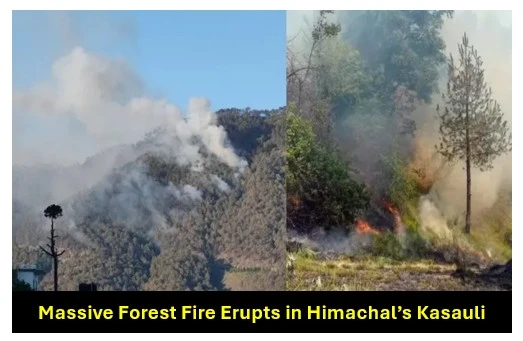
A major forest fire broke out in Himachal Pradesh’s Kasauli region, creating panic across the entire hill town as the fire spread rapidly through dense forested areas adjacent to Solan’s Air Force Station. The combination of high temperatures, dry vegetation, and strong winds has fuelled the fire, resulting in an extensive emergency response from the Indian Air Force (IAF), Army, forest officials, and local fire services.
As the fire progressed, it started near the Jangeshu area of Kasauli and expanded into large areas of pine-covered hills. Pine needles on the ground served as a perfect fuel source to aid in ending this fire very quickly by creating a very flammable environment that allowed the fire to spread quickly throughout steep and inaccessible terrain. In addition, the spread of fire from the forest areas significantly threatened many other areas, including Gilbert Trail, Upper Mall Road, and parts of the cantonment.
Indian Air Force Deploys Mi-17 Helicopters
Residents witnessed massive flames rising from the forested area of Kasauli along with a tremendous amount of smoke coming from the forest. Additionally; due to the high winds, firefighting efforts were being severely hampered. Worrying that the fire could continue spreading into residential areas and/or tourist locations if timely action was not taken prompted the local authorities to request assistance from the IAF.
The IAF responded by sending Mi-17 and Chinook helicopters to the area. The Bambi Bucket system (larger containers filled with water that helicopters can carry under them) dropped thousands of litres of water on to inaccessible areas of the blaze. Officials reported that over 40,000 litres were dropped whilst flying at night using Night Vision Goggles to help the crews deal with fires in difficult and poor visibility conditions.
Firefighting operations lasted for approximately 15 hours with a coordinated joint response amongst those with operational authority: Indian Army, Indian Air Force, the forest, the fire brigade and civil authorities. The ground crews worked overnight to create firebreaks and isolate the areas at risk from spreading by the blaze.
The fire near the Indian Air Force (IAF) Base was successfully brought under control, thereby preventing significant loss of military facilities and civilian buildings and there were no fatalities or injuries associated with the firefighting operations. Firefighting agencies remain deployed at several locations adjacent to the main fire site to extinguish remaining smouldering piles of dirt and ensure that they do not flare up again. Fires were also reported in the area to the north of the site in three other municipalities – Kandaghat, Basal and Shamlech (Solan District).
read also: 14 days curfew announced in Pune
Heatwave and Dry Conditions Fuel Crisis
The forest department points to the ongoing heat wave and heat increases as reasons the amount of forest fires in Himachal Pradesh has increased. On several occasions, the heat in the region has been reported to be close to 40 degrees Celsius in Una or even higher in areas such as Shimla.
According to the Himachal Pradesh Forest Department, there have been over 230 reported incidents of fires within forests impacting nearly 3000 acres of the forest this fire season. The cost of damages/losses due to these fires exceeds ₹67,00000.
The district of Mandi has been responsible for most of the fires followed by Dharamshala and Solan. Forest department officials warn that the dry climate condition plus dry, combustible pine provide great amounts of fuel for potential forest fires within the entire State of Himachal Pradesh.
read also: West Bengal Intensifies Deportation Drive Near Bangladesh Border
Environmental Concerns Rise
Concern about environmental impact due to repeated forest fires has been raised by many environmentalists regarding the devastating effects of the loss of biodiversity, wildlife habitat, air quality and soil fertility will have a negative impact on ecosystems and will drastically affect medicinal plant and young plant growth within the ecologically sensitive mountain areas of Himalayan India.
Many experts site climate change, long dry durations and irresponsible, careless human behaviour for the ever increasing numbers of forest fires occurring in the Himalayan region. For example, smoke from the Kasauli fire and limited visibility from this fire spread to the surrounding communities, causing a major decrease in the air quality in that community.
Government Strengthens Preparedness
To support improved emergency response times related to wildfires, the Forest Department has significantly raised their staffing levels; including a new 24/hour fire control room in Bilaspur. Not only are they sending suppression crews into high hazard areas but they also provided personnel so the Military and municipalities could coordinate their efforts during emergencies.
In discussions with officials from both the Military and Civilian Agencies, they indicated that the availability of employees from each Agency allowed them to respond much quicker when requested assistance was required for Kasauli. Although the immediate danger has passed, officials will continue to monitor this area closely because of the presence of extreme heat with the likelihood that there will be new wildfires throughout the State.
