


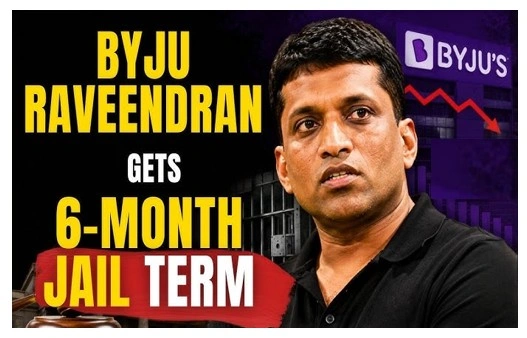
Byju Raveendran, founder of Byju’s, has been sentenced to six months of jail time by the Supreme Court of Singapore for contempt of court. This sentence follows many ongoing legal and financial challenges that Byju’s has been facing for the last 2 years.
Major Blow for the Embattled Edtech Founder
The company began with an estimated value of approximately $22 billion and went through an aggressive growth period with celebrity endorsement contracts, such as the FIFA World Cup, and multiple global acquisition purchases. Some of the most significant sponsorship agreements include being the brand ambassador for Lionel Messi and sponsoring the Indian cricket team.
While the company was growing rapidly, it was acquiring debt to fund its ongoing operations, and the cracks in its business model began forming. The company was also under scrutiny for being late in their reporting to the Financial Regulators, as well as for Corporate Governance issues, aggressive sales tactics, and alleged unauthorized transfers of funds between different companies.
also read: Gautam Adani Case Closed as US Drops All Criminal Charges
What Was The Ruling Of The Court In This Matter?
According to reports, the matter in question before the Singapore Court relates to the alleged failure of Raveendran to follow Court Orders to provide disclosure of his personal assets and ownership interests as ordered by the Court. The claim, related to Raveendran’s alleged non-compliance with a Court Order, was also closely tied to claims by investors (such as the Qatar Investment Authority) against Raveendran.
Bloomberg reported that several other articles have confirmed that the Court determined Raveendran’s repeated failures to comply with Court Orders constituted contempt of Court. The Court’s ruling is part of a broader pattern of international legal proceedings involving multiple banks that are attempting to recover the loss they suffered on Byju’s debt obligations as well as from Byju’s overseas transactions.
In the U.S., the company and its founder are currently under legal scrutiny due to allegations from several creditors that the company has misused money in connection with an alleged $1.2 billion loan. The company has denied the allegations of misuse of funds.
also read: Surya Midha becomes the youngest self-made billionaire
Raveendran Declares “It’s a Procedural Matter”
Byju Raveendran defended himself in the waking moments of the legal verdict. He characterized the issue as a “processing issue” versus fraud or dishonesty, arguing that they were nearing the end with lenders, investors, and other stakeholders to resolve the matter.
Raveendran expressed sadness regarding the perception of the legal issue by quoting several articles in his statement. In Raveendran’s opinion, the timing of the lawsuit could have a negative effect on the pending settlement with the lender.
Despite Raveendran’s response to the case, it represents one of the most severe legal actions against a founder.
also read: Anant Ambani’s Vantara Creamery Launches 17 Desi Flavors
A Wake-Up Call To India’s Startup Community
The downward spiral of BYJU’S has become one of the largest and most noted collapses of a startup since the dawn of the startup era. After all the excitement about BYJU’S as a revolutionary and technical way to learn, it now faces the possibility of going into bankruptcy and countless lawsuits from US investors, and scrutiny from global regulators.
The recent developments have sparked a larger dialogue regarding the issues surrounding the field of corporate governance within the Indian startup sectors; in particular, analysts have pointed fingers towards the Byju’s incident as evidence of the lack of appropriate oversight for growing businesses, the impacts of extreme dependence on venture capital, and the risks associated with rapid and unchecked growth.
In addition, there have been many negative comments on social media, where many users feel that the sentencing of Byju’s founder was a clear example of the dramatic downfall of such a prominent figure in India’s startup community, who once represented the hope of the nation’s entrepreneurial future.
With legal actions remaining active in multiple countries, the fates of both the founder and the company are still unclear. Many observers view the case as an example and precautionary tale of how quickly the successes enjoyed in the startup world can be reversed when the founder’s governance and financial discipline come into question.
