


India-Netherlands ties, based on common democratic values and a long association, moving to higher gear. The 13th session of Foreign Office Consultations (FOC) that took place recently in the Indian capital wasn’t your regular diplomatic affair; it was a clear assertion from both countries that they are set to further enhance their partnership across new and sensitive frontiers, not sticking only to conventional fields but embracing futurology.
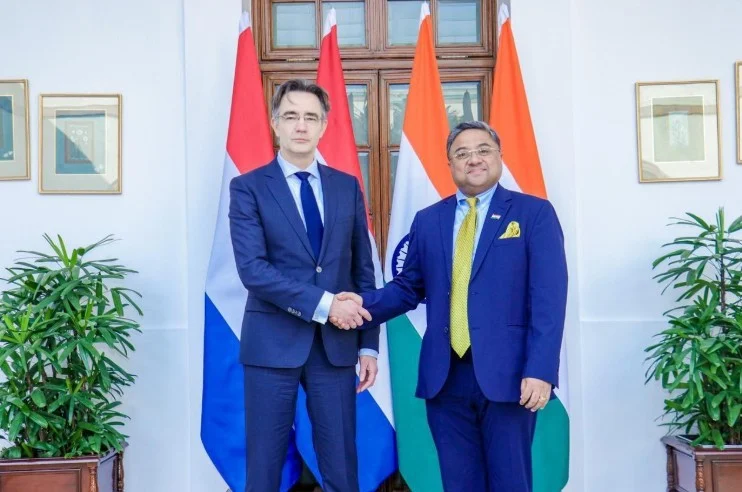
Chaired by senior officers—Secretary (West) Sibi George from the Indian and Secretary General Christiaan Rebergen from Dutch Ministry of Foreign Affairs—the exchange was a comprehensive health check on bilateral ties, other than giving road-map for strategic cooperation. There was an air of respect and willingness on both sides to use each other’s strengths in an evolving world.
The Next Frontier: Critical Technologies and Green Hydrogen
The most dramatic change in the discourse was that of high technology and the world demand on energy. Realising that innovation will power economic strength in the future, both sides resolved to add a strategic twist to their technology partnership.
Critical Technologies -A major emphasis on collaboration in hi-tech areas such as semiconductors and Artificial Intelligence (AI). The Netherlands, which has a world-class ecosystem and players including ASML in the semiconductor value chain — is an important pillar for India’s push towards self-reliance in this strategic sector.” Partnership in these fields will take the form of trade and co-funding projects.
Green Hydrogen and Green Corridor: The drive towards a net-zero future was an undercurrent. The negotiations intensively looked into potential cooperation on green hydrogen, a technology deemed essential in decarbonising economies. There are already talks about launching a Green and Digital Corridor between big ports, Port of Rotterdam and Deendayal Port Authority Kandla at India. This route is being set up to enable the export of green hydrogen and its derivatives (such as Ammonia & Methanol) over the Netherlands for Europe.
This emphasis signals an explicit recognition of India’s lofty climate targets and manufacturing push dovetailing with the Netherlands’ experience in sustainable responses, logistics etc.
Maiketso Molelekwa Maintaining the Core: Trade, Investment and the WAH Agenda
Even as innovation captured the headlines, ground realities of this partnership— economic links and existing sectoral cooperation –were reasserted with emphasis on further expansion.
You may also like this:
- Uday Kotak Welcomes Major Reform Opening Indian Banks
- Why Indians are suddenly crazy about Black Friday deals
- When Will India’s New Labour Code Changes
- Rs 90 to a Dollar
- Tips to hire a marketing company
A European Economic Gateway
The Netherlands remains an important trading partner for India in Europe. It is India’s largest merchandise export destination and one of the major sources of Foreign Direct Investment (FDI) in Europe with cumulative inflow of FDI exceeding USD 52 Bn from April 2000 to September, 2024. Both sides noted that trade and investment between the two countries have been growing steadily.
Importantly, they emphasized the need to conclude by the end of 2021 an India-EU Free Trade Agreement (FTA), which is postulated to create a huge opportunity in market access for businesses on both sides as well as promote economic trade.
Water, Agriculture, and Health
Under the auspices of the successful Strategic Partnership on Water, Agriculture and Health (WAH) agenda, in its previous run, progress was discussed and perceived as steady. The global expertise of Netherlands in terms of water management, conservation agricultural culture is utilized and optimally used in India.
Water Cooperation: Work continues on large projects such as the Namami Ganga Programme, with support from Dutch knowledge and technology in water conservation and flood management.
Agriculture: Attempts are being made to setup 25 Centres of Excellence (CoEs) in India’s farm sector by 2025 and seven such CoEs have so far become operational on advanced farming practice and agri-innovation.
