


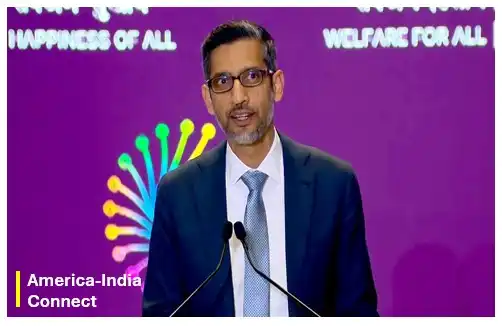
The digital terrain of the Global South shifted dramatically this week at the India AI Impact Summit 2026 in New Delhi. Beneath the whir of high-level diplomacy and technological zeal at Bharat Mandapam, Google CEO Sundar Pichai pulled up a chair to announce a project that sounds more like nation-building than corporate conquest.
Called the “America-India Connect” project, Google plans to lay more than $15 billion worth of subsea fiber-optic cables over the next five years that will loop connectively bind the United States and India across four continents. This isn’t just a matter of speeding up YouTube buffering; it is the building out of a high-speed nervous system to fuel the next generation of artificial intelligence.
A new electronic port at visakhapatnam
For decades, India’s internet connectivity has been dependent on subsea landings that brings cables into Mumbai and Chennai. Though it worked, this ramping-up also represented a single-point bottleneck and failure mode. Google’s new effort reconfigures the map by having Vizag become one of the largest international subsea gateways.
The America-India Connect comes with three key subsea cables, which also will shift the way data flows across the lower half of the globe:
The South Pacific Route: Vizag to Singapore, and on to the American West Coast via Australia and the Bosun/Tabua systems.
A direct fiber-optic route between Mumbai and Western Australia that interconnect with the TalayLink and Honomoana systems to offer a redundant path through the Pacific to the U.S. West Coast.
By diversifying those connections, Google is effectively creating “digital insurance” for India. Whether a cable is cut in the Red Sea or a landing station in Mumbai is disrupted, India’s AI backbone is built to withstand it with the new (Vizag and Chennai) corridors.
The Role of Cables in the ‘AI Divide’
Infrastructure is the bedrock,’” he said in his keynote address, adding later: “the digital divide turns into an AI divide.
Through this $15 billion investment in these ground-based cables and in a gigawatt-scale AI hub (which will have a comparable brain-power equivalence) in Vizag, Google is making sure the “speed of thought” for Indian innovators are at power with Silicon Valley’s. This investment is an effort to democratize access, so that a student in a rural school district receives the same near millisecond-level response from an AI assistant as their developer in San Francisco.
More Than the Gear: The Power of the People
The cables are the “pipes,” but Google’s announcement also drilled down into the “water” flowing through them: knowledge and opportunity. The $15-billion project is twinned with a giant skilling push to prepare India’s workforce for an AI driven economy.
Educating the Guardians of the State
One of the most ambitious parts of the plan is to collaborate with Karmayogi Bharat. Google Cloud will offer secure infrastructure on the iGOT (Integrated Government Online Training) platform to all Indian public servants via multiple digital channels, anywhere anytime. Utilizing AI-powered digital tools in 18 Indian languages, the programme is hoping to shape a civil service for the future that can use technology more effectively while serving the public.
Google also cast its gaze to the next generation:
ATAL Tinkering Labs: Google in partnership with NITI Aayog, will bring AI and generative adversarial networks (GANs) to 10 million students across more than 10,000 additional schools. The emphasis here is on “learning by doing” — bringing robotics and coding into the classroom.
AI for Science: Google DeepMind is collaborating with Anusandhan National Research Foundation (ANRF). Indian scientists will be able to use specialized models like AlphaGenome and Earth AI, going beyond simple chatbots to apply AI for solving “planetary-scale” issues such as climate change and disease.
A Greener, More Reliable Future
The new “America-India Connect” is more than a corporate landmark; it’s an acknowledgment that the tech world’s center of gravity is changing. With an investment of $15 billion to lay thousands of miles of glass fiber beneath the ocean, Google is not simply hedging its bets on India’s future — it’s laying the foundation upon which that future will be written.
The summit ended with an air of inevitability: the cables are coming, the data is flowing and for India, the “AI era” has made its way from the boardroom to a high-speed physical reality.
