


Prime Minister Narendra Modi’s trip to Ethiopia — the first by an Indian premier in 34 years — is no mere photo-opportunity. It is a defining decision for Indian foreign policy, which places New Delhi strategically at the intersection of African geopolitics, its own agenda for Global South and the long road ahead for economic expansion. With its natural advantage of being the headquarters of African Union and a major actor in the Horn region, Ethiopia offers India an anchor to grow its continental and global dreams.
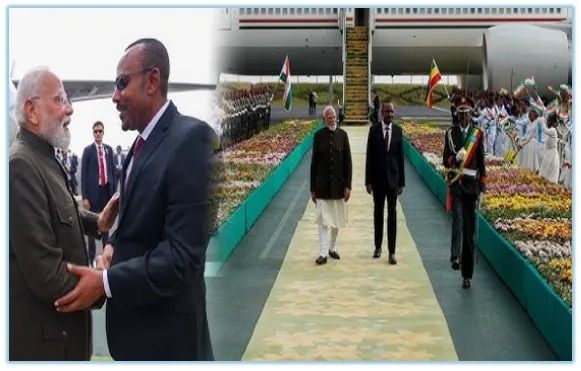
This visit is loaded with significant diplomatic heft, especially post Ethiopia’s recent accession to the BRICS club (a membership India has vigorously championed) and seeks to convert an age-old historical friendship into a multi-dimensional, en-firmed strategic partnership that can endure.
Ethiopia: Africa’s and the South’s Gateway
Here is why Ethiopia is an inescapable partner for India: 1.Three big strategic reasons that are in coherence with New Delhi’s aspiration of being a leading voice of the developing world:
African Union (AU) headquarters: By serving as the headquarters of the AU, Ethiopia becomes the diplomatic center of Africa. Dealing with Addis Ababa enables India to articulate, and execute its “Africa First” policy – a development paradigm that is premised on partnership through knowledge and technology transfer rather than the transactional road taken by other powers. The visit also offers a critical opportunity to establish the ground for the much-delayed 4th India-Africa Forum Summit (IAFS).
Strategic Position in the Horn of Africa: The Horn of Africa, which is neighboring the Red Sea, is a critical area for international maritime transport and security. Deepening the relationship with Ethiopia, does integrate India more into the contested yet collocated geopolitical and geo-security domains of the Horn of Africa as well as those of Indo-Pacific region in a wider frame. A strong and stable Ethiopia is critical to ensuring regional peace and securing sea routes.
BRICS and World leadership: Both India and Ethiopia are now part of the extended BRICS group. Given that India would be chairing the BRICS Summit in 2026, it is opportune to visit for coordinating positions on intra-BRICS cooperation, UN reforms and mutual strengthening of common agenda of the Global South to outreach developed countries -which is principle take-away of Indian diplomacy.
The Economic and Development Pivot
With an eye on addressing challenges faced by the Ethiopian economy, during the visit focus will not only be to promote India’s large investment footprint in Ethiopia but also work more closely on some of the development projects for direct benefit of Ethiopian people.
India is already Ethiopia’s second biggest trade partner and among its larger sources of foreign investment with more than 650 Indian companies having businesses in the country, which it estimates to be over $4 billion. These companies are known to be among the biggest private employers in Ethiopia – a visible illustration of Indian economic participation.
These are some of the focus areas where the visit will see strengthened cooperation:
Digital Public Infrastructure (DPI) and ICT: India is interested in offering its experience in digital technology, including UPI-based payment systems to aid Ethiopia’s agenda of digitisation and governance reform.
Capacity Building and Education: India’s time-tested education cooperation with Ethiopia is being revitalised, with thousands of Ethiopian professionals receiving Indian scholarships and more than 150 faculty members from Ethiopia having received training in Indian Universities. This focus on people-centred development is a hallmark of India’s South-South cooperation paradigm.
Core Sectors: New investment avenues were defined in agriculture (the sector supporting 80% of Ethiopian livelihoods), mining for critical minerals and RE, specifically under projects initiated by the International Solar Alliance (ISA) on solar pumps, and off-grid solutions.
Coupled with geopolitical positioning, PM Modi’s visit reaffirms India’s optics as a committed long-term partner in Africa by extending tailored and sustainable developmental assistances. It highlights a foreign policy pivot in which India deploys its skills in development and its economic weight to forge strategic alliances that help it project itself as an ascendant global power.
