


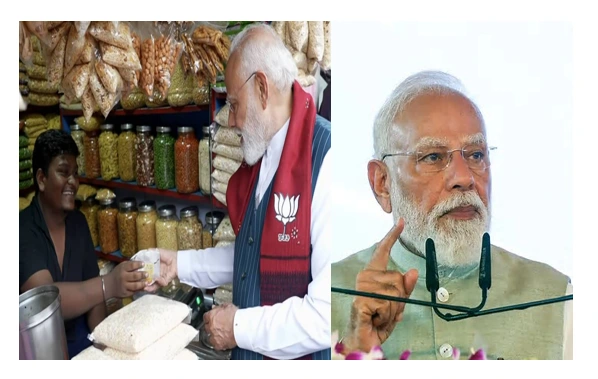
Prime Minister Narendra Modi made a flippant remark during his West Bengal election campaign that caught people’s attention and became a point of discussion; “We eat onions, not brains!” PM Modi’s comment provided levity to what has otherwise been highly contested political competition in West Bengal, with a great deal of negativity from both sides, and many large gatherings to promote each candidate.
The Background of the Comment: A Light Moment Amid High-Stakes Campaigning
At the time of PM Modi’s comment, there was a discussion about food and how each individual has their own way of living. As part of his normal speaking style, PM Modi often uses humour and phrases that are commonly used by everyday people to connect with his audience; therefore, he probably made the comment to provide a unique viewpoint on living an uncomplicated life, versus worrying about all the things that are going on in your life.
While the subject matter of the comment has nothing to do with either political issues, it did have enough of an interest and wanted for the people of West Bengal, that they now want to know if PM Modi’s comments were meant to send a message to them in a humorous way. Those who support PM Modi see it as a light-hearted behaviour to someone who is not very sophisticated, while others may question if the phrases he used had any political implications.
Campaign Climate in West Bengal
In West Bengal, the political environment is very tense due to various parties competing for power. The state has been a historically important political battlefield with many parties producing very aggressive, confrontational campaign rhetoric throughout the years.
Modi broke this trend by using a humorous comment to take the focus away from the normal aggressiveness of campaigning. Modi’s campaign for the region has focused on the issues of Development, Government and National issues but has also included attention to local issues such as Infrastructure, Employment and Welfare programs.
Read also: PM Modi Plucks Tea Leaves During Assam Visit Goes Viral
Reactions From The Public and Politicians
As expected, the statement was widely publicized on Facebook and Twitter and received mixed public and political responses. Supporters of the Prime Minster found the statement to be funny and relatable and noted that the Prime Minister has a unique ability to relate to every day people through very simple phrases.
Opponents of the Prime Minister did not seem impressed. They made statements that such comments are taking away from serious discussions about policy and instead, they suggested that the meaning of the phrase is very dependent on the context of the statement. Political analysts also noted that the speed at which off the cuff comments can spread can easily overshadow any detailed messages used by most candidates in their campaigns.
The Role of Humor in Political Messaging
Throughout history, humour has been a common way for politicians to communicate because it makes them relatable to their audience. In the case of Indian politicians—including their use of regional languages, local jokes or idioms—this is particularly true.
Modi has made an effort to mix messages with light-heartedness when giving speeches or speaking with people, which helps keep the audience engaged and can lead to additional news coverage for his campaigns.
However, humour can have both positive and negative effects in political discourse; although it may create a sense of relatability/connection for the listener, it could easily be misinterpreted or analysed in multiple ways because of how partisan our society is currently.
Amplification and Viral cues of the Media
Candidates have the ability to take advantage of today’s technology; even a one-word comment can spread like wildfire. Modi had an example of this when he made a comment regarding how expensive onions were. The audio and/or video of this statement were then copied and transferred to different websites as people created memes, discussed his comments and also analysed Modi’s comments from a political perspective.
This all demonstrates that political campaigns are no longer restricted to speeches or manifestos. Catchy phrases, regardless of how short they are, have become a focal point in many political discussions and also affect how people perceive politics (and candidates) through different perspectives.
Conclusion: Beyond the One-Liner
Although “Piyaaz khate hain, dimaag nahi khaate” seems like a straightforward, comical statement, its significance comes from its reception and interpretation. In a politically charged environment like West Bengal, even casual comments have meaning and can ignite political discussion.
For Narendra Modi, the quote illustrates his style of communication—using informal language along with messages designed to appeal to a large audience. Regardless of whether the comment is perceived as funny or purely symbolic, it has created another memorable moment in an already dynamic political campaign.
As the elections continue, these types of moments will likely continue to develop the stories we are observing and remind people that even the smallest of comments can make an impact in politics.
