


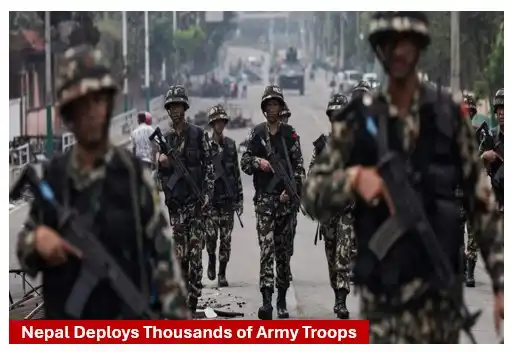
As the sun begins to rise on the snow-capped Himalayan mountain range in early February, tens of thousands of pairs of army boots thump against the streets of Kathmandu, and a nation tells a story about itself.
This is not just another garden-variety election. It is a time of deep political reckoning for Nepal, after a year of turmoil that included the “Gen Z Uprising” popular protest that reordered the country’s leadership. Deployed to secure a transformational moment in Nepal’s quest for national rebirth, nearly 340,000 security personnel fanned out across the nation in what amounted to one of largest peacetime security operations that Nepal has ever undertaken.
The Burden of History: Why the Army is Gone So Soon
For context, we have to go back to September 2025. A youth-led protest that took form on the streets of Kathmandu was driven by frustrations with corruption and digital censorship, and was disseminated through thousands of young Nepalis — the so-called Gen Z protesters. Veteran Prime Minister K.P. Sharma Oli stepped down after the unrest, and replaced by Sushila Karki as part of an interim government.
The wounds of that time are still raw. At least 77 people were killed in the midst of the protests and government buildings were set ablaze. Thus the Ministry of Home Affairs and National Security Council have taken no chance for granted.
Amid Freezing Winter Army Intensifies Ops In J&K Against Terror
A three-layered fortress: The integrated security plan
Security is being deployed in three types of “rings” to ensure all polling booths, including those on the plains of Terai or the high-altitude villages of Mustang, remain secure.
The Inner Ring:Nepal Police and Election Police
There is the first line of defense, some 77,000 Nepal Police personnel and an incredible 133,000 “Election Police” on temporary duty. Most of these ad hoc recruits are young people who have been taught to manage lines.
The Second Tier: APF
The APF is the quick-reaction force. They have some 33,000 personnel standing by just outside the purview of the polling centers to rush in if local skirmishes erupt among warring political parties.
The Outer Ring: The Nepalese Army
The last line of defence for peace is the Nepali Army. And they are in (2) the third-most security ring, with a strategic overwatch. Their duties are high-stakes:
- Ballot Box Security: However, ensuring the integrity of the vote during transit.
- Strategic Infrastructure: Taking over security at airports and prisons so that regular police officers could be freed to work the streets.
Aerial Surveillance For the first time, the Army has made its helicopters available for aerial patrols in “highly sensitive” blocks.
Mapping the Risk: Highly Sensitive Polling Places
Intelligence agencies have effectively classified the country into three layers of risk – Normal, Sensitive and Highly Sensitive. This year, the “Highly Sensitive” polling stations have increased with 3,680—compared to the 2022 elections.
A number of things have led to this raised alarm:
- High-Profile Contests: There is 24-hour-checking on Gorkha-1 (where Gen-Z leader Sudan Gurung is contesting) to Jhapa-5 (where Independent Balen Shah takes on K.P. Sharma Oli).
- The Border Factor: Districts including Banke (with open border with India) are on high alert to check against the flow of illegal materials or exploratory crossing on polling day.
- History of Strife: Notorious for political turbulence –Violence Gets Sent Off The Army and Police have undertaken “sanitization” in places such as Rolpa and Saralhi, which face a long election campaign beginning on 16 February.
Coming up: A test for democracy
As the ballot papers are printed as if on “war-footing” and international community —including UN and other diplomatic missions—watches, Nepal is at a turning point. The heavy presence of military is both positive and negative: It provides safety, but it also underscores the fragility of the peace.
