


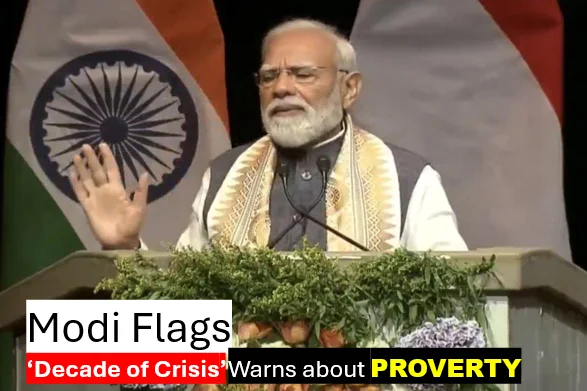
India’s Prime Minister Mr. Narendra Modi has said the globe is going through a “decade of crisis” due to COVID-19, wars and rising energy crisis. He warned that if corrective measures aren’t taken quickly enough, unsustainable progress made over the last decades’ will regress across continents.
In the Netherlands on Friday addressing Indian Diaspora in The Hague, Modi highlighted that a multitude of disruptions are occurring globally, which threaten nations’ economies and society.
Pandemic, Wars, Energy Crisis
Modi reasoned that last world’s lost decade can be attributed to vast accumulations of many events throughout multiple years that destabilised economies; COVID-19 pandemic had majorly impacted the world economy followed by regional & international conflicts (wars) impacting economy as well as now globally resulting in an energy crisis.
“The first was COVID-19; second was the associated geo-political conflicts; and thirdly there is now the international energy crisis, so this Decade has quickly became a Decade of Disasters for the World as well.” – Prime Minister Modi
Many countries are looking for economic recovery from COVID-19 while also addressing surging global inflation as a direct result of recent energy supply crisis followed by increased credit or interest rate charges due to persistently rising global food and fuel shortages caused by regional conflict or geopolitics diversions hampering trade flows.
Warning Over Rising Poverty
The Prime Minister stated that, without taking swift action on the current global climate, all progress made in recent decades could be undone.
A large portion of the global populace might revert back to poverty because of continued instability, inflation, and economic downturns. According to Modi, the repercussions of unending crises would not remain contained in individual nations, but rather be felt globally.
His comments reflect the apprehension of many around the globe regarding slow growth rates, high energy prices, and supply chain interruptions causing issues to developed and undeveloped economies.
Read also: What did PM Modi addressed the nation after women quota bill fails Lok Sabga test?
Stressed the Need for Resilient Supply Chains
The need for cooperation internationally is stressed by Modi as he stated that the Government of India and the Netherlands are collaborating to develop resilient, future-ready supply chains.
He also mentioned that establishing a trusted and transparent system of supply chain networks would be vital for minimising dependency risks and maintaining economic stability in times of crisis. He stated that a stronger set of global partnerships would provide protection for trade and assist with the uninterrupted supply of crucial resources.
He continued that resilient supply chains are being increasingly discussed throughout the world due to the exposure of vulnerabilities during the COVID-19 pandemic and continuing geopolitical conflicts.
India’s Expanding Global Role
Modi’s speech mentioned India’s increasing importance in global economic activity, positioning the country as both ‘technology-oriented’ and ‘humanity-focused’. He stated that India is advancing toward becoming a modern nation while adhering to its ancient traditions.
He cited how various reforms by India, rapid growth in digital technology, and developing greater cooperative efforts with other nations demonstrate that India is rising as a major player in global markets. At the global business Summit earlier this year, Modi remarked how the disruptions experienced worldwide had created a decade of unmatched development for India.
Read also: PM Modi urges to conduct class online for saving fuel
Five-Country Diplomatic Tour
The Netherlands was visited as part of Modi’s ongoing diplomatic trip to five countries focused on developing stronger strategic and commercial relations with partner nations. The emphasis of this visit has been on trade relations, cooperation in technology, and common resilience of global economies. He further reinforced the message of his presentation to the Indian diaspora by indicating how overseas Indians can aid in building stronger bilateral relationships and creating a greater cultural and commercial identity for India internationally.
