


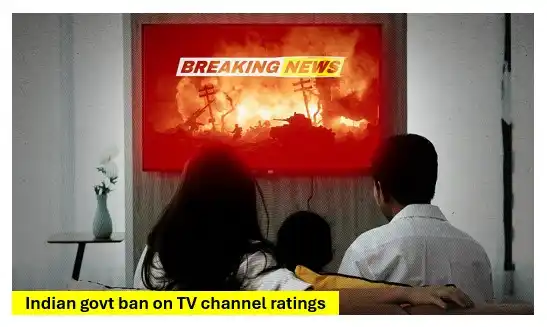
With a flicker of a television screen sometimes determining the beat of a nation in an age, the Indian government has made a decisive stand on the theater of war. On March 6, 2026, the ministry of the information and broadcasting (MIB) asked the broad cast audience research council (BARC) to cancel the release of Television Rating points (TRPs) on all news channels immediately.
The four-week restriction, which was originally meant to last four weeks, is a severe regulatory measure intended to put down a notch in the potentially overheated, more or less speculative media coverage of the growing war in West Asia between the U.S., Israel, and Iran. It is not a decision merely on the side of data, rather it is a decision to humanize the news and to take the decency of journalism back out of the clutches of an unforgiving number rush.
The Business of Panic: The Ratings in the Wartime
One has to know the intoxicating power of the TRP before he can understand the move of the government. TRPs are not just figures in the world of Indian broadcast media, but also the currency that sells advertising spots and determines whether a newsroom has a budget or not.
When a fight erupts, the number of viewers is bound to increase. The pressure to stay “Number One” however, usually drives newsrooms towards fine-tuning to noisiness. We have witnessed the battlefields turned into digital news studios where anchors stand amidst computer-generated explosions and scrolling “Breaking News” tickers stating that the world is about to blow up.
According to the Ministry this unnecessary sensationalism was no longer an issue of bad taste, it was now an occupational health hazard. To the millions of Indians whose family members work in the Gulf, or even to those who are just trying to make a living in a hostile global economic climate, these sensational presentations are not educative; they are frenzied. Freezing the ratings, thus, has in effect eliminated the economic incentive of going over the top of each other by the channels.
Humanizing the Headlines: Not the Big Bang Graphics
Being a war correspondent is a serious task. It is the art of recording human misery, geopolitical changes and the silent heroism of people who are caught in crossfire. However, as far as ratings become the driving force behind the story, the first casualty is the human aspect.
The new directive is pushing the government to revert to the basics of ethics. The idea is to get beyond guesses about time running out, the next two hours are crucial, and to corroborated, factual reporting.
The Ethical Shift
- Acquiescence over Agility: It is better to focus on the facts that have been verified by the Ground Zero of the conflict, as opposed to repeating the unverified social media clips.
- Empathy over Exploitation: Feeling the dignity of the victims and the anxiety of their families they have to leave at home in India.
- Context over Clutter: Substituting flashing red lights with professional advice as to the impact of the conflict on global oil prices, Indian exports, and how it impacts the regional stability.
Television news must be a window on the world, not a fun house mirror which skews the reality to keep the viewer addicted. General feeling among New Delhi media ethics lobbyists.
The Legal Support: Clause 24.2 and Public Interest
The government did not do this out of the blue. The ruling relied on Clause 24.2 of the Policy Guidelines of Television Rating Agencies in India (2014)*. According to this appropriation, the Ministry has the authority to give instructions to rating agencies such as BARC on behalf of people and national sovereignty.
It is not the first time when such a sort of a blackout has taken place. The same suspension occurred in 2020, in the TRP manipulation scandal. Nevertheless, to employ it today namely referencing the sensationalism of war is a change in the psychological influence of the media as viewed by the state. The point is obvious: the right to profitable business model does not take precedence in the right to calm and correct information about the world crisis by the people.
